 GTM Universe
How to Close Your First 10 B2B Customers as a Founder
By Rajat Kharbanda,
I was deep in a conversation with a prospect I had been building for weeks. Good fit, clear problem, real budget. We got to pricing and I told him the number.
Before he could say a word, I jumped in. Offered a 20% discount. Added a money-back guarantee if results did not come through. Threw in two extra deliverables. In thirty seconds I had stacked three offers on top of each other trying to make it easier for him to say yes.
He stepped back. The deal went quiet. I never closed it.
What I did not understand then was that I had made the decision harder, not easier. Three offers on the table is not generosity. It looks desperate. It signals that you do not believe in your own pricing. And the moment a prospect senses that, the trust you spent weeks building starts to dissolve.
That mistake, and others like it, is how most founders lose early deals that should have closed. Not because the product was wrong. Not because the price was too high. Because the closing motion was broken.
What does closing first B2B customers actually look like?
Closing your first 10 to 20 B2B customers is not a sales event. It is a journey, and it moves in steps. B2B buying is not an impulse. The higher the ticket size, the more steps are involved, and the more the buyer needs to feel safe before they sign.
The founders who close fast understand this. They do not try to compress the journey. They move through it deliberately, earning the right to ask for the sale.
The founders who stall are usually trying to skip steps. They jump from the first call to the close without building the trust, the proof, and the alignment that make a yes feel obvious rather than risky.
You cannot rush a B2B close. You can only move through the stages faster by executing each one better.
The single biggest mistake founders make when closing early deals
It is not the pitch. It is not the pricing. It is not even the follow-up.
It is talking when they should be silent.
Most founders, when they make the ask, immediately fill the silence that follows. They restate the price. They offer a discount. They add deliverables. They justify the investment before the prospect has had a chance to respond. Every word spoken after the ask gives the prospect a reason to hesitate instead of decide.
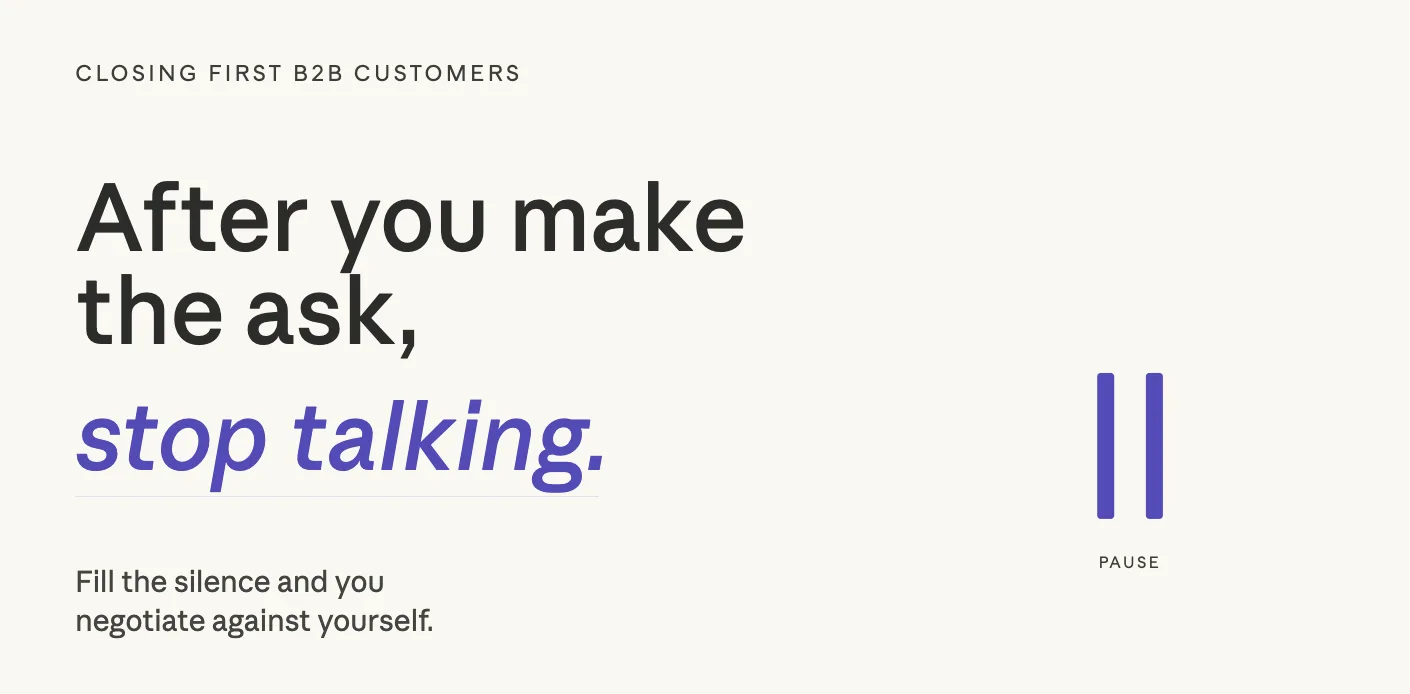
The discipline of silence is one of the hardest things to develop in early-stage selling. After you state your price or make your proposal, stop. Wait. Let the discomfort sit. The next person to speak reveals where the real objection is. If the prospect speaks first, you learn something. If you speak first, you have just negotiated against yourself.
The other mistake is making the decision too complicated. One offer, clearly presented, is easier to say yes to than three offers stacked on each other with conditions attached. Simplicity signals confidence. Complexity signals doubt.
After you make the ask, stop talking. The silence is working for you.
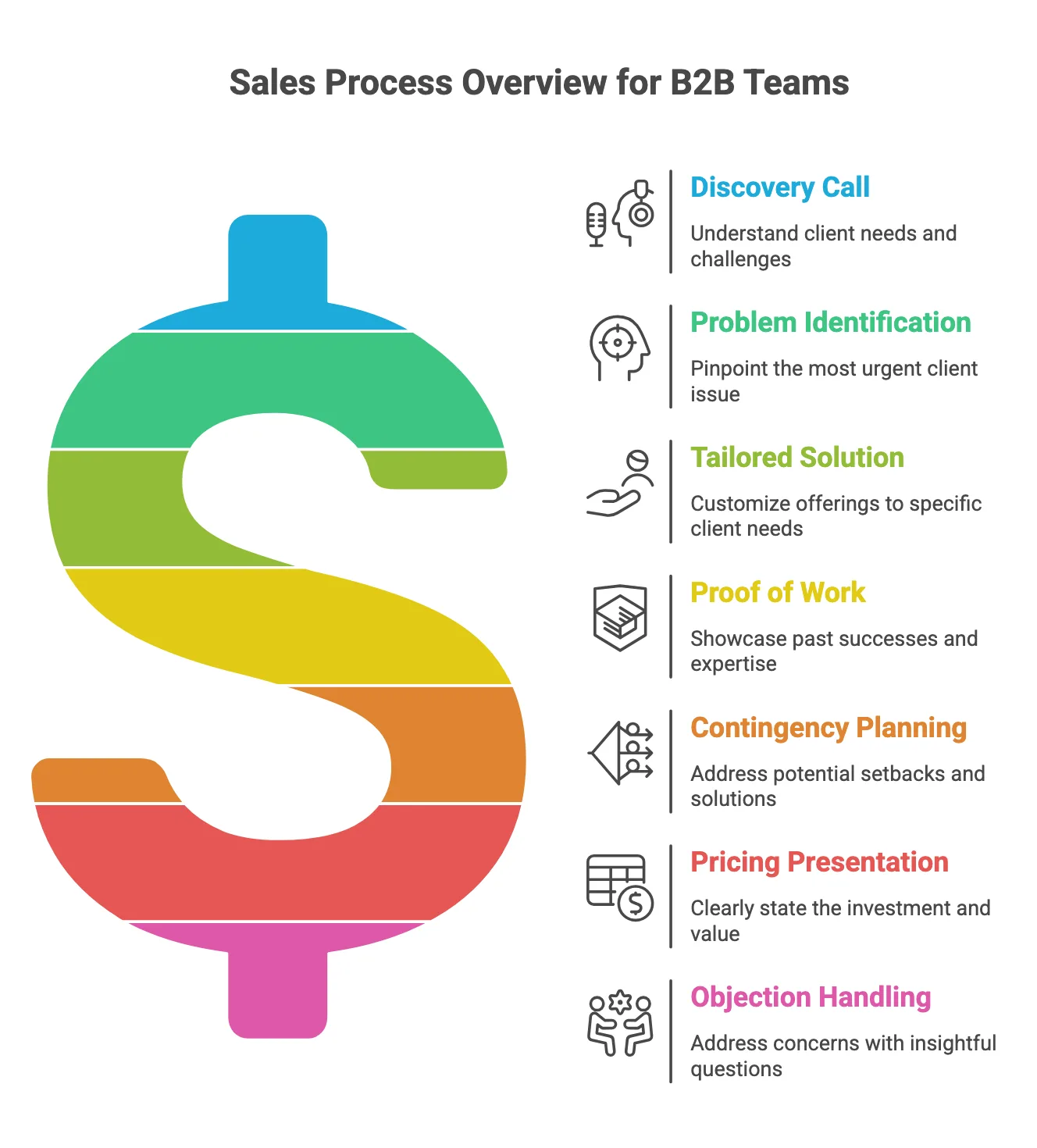
The step-by-step B2B closing process for early-stage founders
This is the sequence. Each step earns the right to move to the next one. Do not skip steps.
Discovery call. Your first job is not to pitch. It is to understand. What is the problem they are dealing with, how long have they had it, what have they tried, and what does it cost them to leave it unsolved. The better your discovery, the easier every step that follows becomes.
Identify the most painful problem. Out of everything they tell you, find the one problem that is affecting them most acutely right now. Not the most interesting problem. The most urgent one. The one they are accountable for. The one that comes up in meetings. That problem is the thread you pull in every conversation from this point forward.
Tailor the solution to that problem. Do not present your standard offering. Present what you would do specifically for this person and this problem. Walk them through your approach step by step. Name the milestones. What happens in week one, week two, week four. What does success look like at the end. They are buying confidence that your solution will work for their specific situation, not a generic service.
Show proof of work. Case studies, past results, a framework, a client story. Something that shows you have done this before and it worked. The proof does not need to be perfect. It needs to be honest and specific. Vague testimonials do not build trust. Specific results from similar situations do.
Address what happens if it does not go to plan. This is the step most founders skip. Talk about what your process looks like when things do not go perfectly. What happens if the first round of outreach does not convert. What does iteration look like. Showing that you have thought about failure and have a plan for it makes the investment feel safer, not riskier.
State the price. Then stop. Present one clear offer. State the price. Stop talking. If the objection is price, you will hear it. If the objection is timing, you will hear that. If the objection is internal approval, you will hear that too. Each objection is information. None of them require you to immediately discount or add more to the offer.
Handle objections with questions not concessions. When an objection comes, get curious before you respond. “What would need to be true for this to feel like the right investment right now?” or “Is it the price itself or is there something else making you hesitate?” Most early objections are not about price. They are about trust, timing, or clarity. Discounting solves none of those.
How to handle the pricing conversation without panicking
Most founders dread the pricing conversation. They either throw the number out too early, before the prospect understands the value, or they delay it so long that when it finally comes it lands without context.
Timing matters. State the price after you have walked them through the solution step by step, after you have shown proof, after they understand exactly what they are getting and what success looks like.
Then stop.
If the objection is price, explore it. “Is it the overall investment or is it the timing?” Very often what sounds like a price objection is actually a budget cycle objection, or a concern about ROI, or a need for internal sign-off. None of those require you to lower your price. They require you to address the actual underlying concern.
The founders who hold their pricing in early deals are the ones who communicate value clearly before the number appears. The founders who panic and discount immediately are the ones who arrived at price before the prospect understood what they were buying.
What separates founders who close in 3 months from those who take 12
It is not luck. It is not a better product. It is three things, and they compound.
Urgency of the problem. Founders who close fast are talking to buyers who feel the problem now, not in theory. They have a sharp enough ICP that every conversation is with someone who has already tried to fix this and failed, or whose business is actively suffering because of it. Urgency is found by targeting the right person at the right trigger point.
Speed of diagnosis. Fast closers run better discovery calls. They identify the real problem, not the stated one, faster. They can name back the prospect’s pain more precisely than the prospect can name it themselves. When a buyer hears their own problem described with that kind of clarity, trust is built in minutes instead of months.
Confidence in the solution. Founders who close fast believe their solution works. Not arrogantly, but deeply. It means they do not panic when there is silence after the price. It means they do not stack offers when the prospect pauses. It means they can sit with uncertainty without filling it with concessions.
The 12-month founder is usually working on the wrong variable. They are refining the deck, adjusting the pricing, trying a new channel. The real issue is almost always that they are talking to buyers who do not feel the problem urgently, running surface-level discovery, or communicating price before value. Fix those three things and the cycle compresses.
If your deals are stalling or not closing, book a 30-minute discovery call to diagnose what is breaking.
Frequently asked questions about closing first B2B customers
How do I close my first B2B customers as a founder?
Move through the closing process in steps: run a real discovery call to identify the most urgent problem, tailor your solution specifically to that problem, show proof of work from similar situations, address what happens if things do not go perfectly, then state your price once and stop talking. B2B closing is a journey, not a single event. Each step earns the right to the next one.
What is the biggest mistake founders make when closing early B2B deals?
Talking after they make the ask. Most founders state their price and immediately fill the silence with discounts, additional offers, or justifications. This signals a lack of confidence and makes the decision harder for the prospect, not easier. State the price once, clearly, then wait. The next person to speak tells you where the real objection is.
How do I handle pricing conversations as a founder without discounting?
Present the price after the prospect fully understands the solution, the process, and the expected outcome. Price stated after value is received as an investment. Price stated before value is received as a cost. When objections come, explore them with questions before responding. Most pricing objections are not about the number itself. They are about timing, trust, or internal approval.
Why do some founders close their first 10 customers quickly while others take much longer?
Three factors: urgency of the problem in their target buyer, quality of discovery that identifies the real pain fast, and confidence in their solution that prevents panic discounting. Founders who close slowly are usually targeting buyers who have the problem but do not feel it urgently, running surface-level discovery calls, or presenting price before value. Fix those and the sales cycle shortens.
Related: Founder-Led Sales: The Complete Guide for Early-Stage B2B | ICP Definition for B2B SaaS Founders | When Should a Founder Stop Selling and Hire a Salesperson?