 GTM Universe
When Should a Founder Stop Selling and Hire a Salesperson? (The Real Answer for 0–$1M ARR Founders)
By Rajat Kharbanda,
Most founders ask this question at the wrong time.
They ask it when a demo drains them. When the pipeline starts feeling heavy. When building the product feels easier than being on a Zoom call with a skeptical US prospect at 9 PM IST. When a co-founder casually says, “Should we just hire someone for sales?”
I work with early-stage B2B SaaS and AI founders, most of them building in India and selling into the US. And the single most expensive go-to-market (GTM) mistake I see, consistently, is hiring a salesperson before the founder has done the real work of founder-led sales.
This is not about whether you like selling. This is about whether you have built something worth handing over.
The One Signal That Actually Tells You You Are Ready
People Google “when should I hire a salesperson for my startup” expecting a headcount formula or an ARR threshold. The reality is simpler and harder.
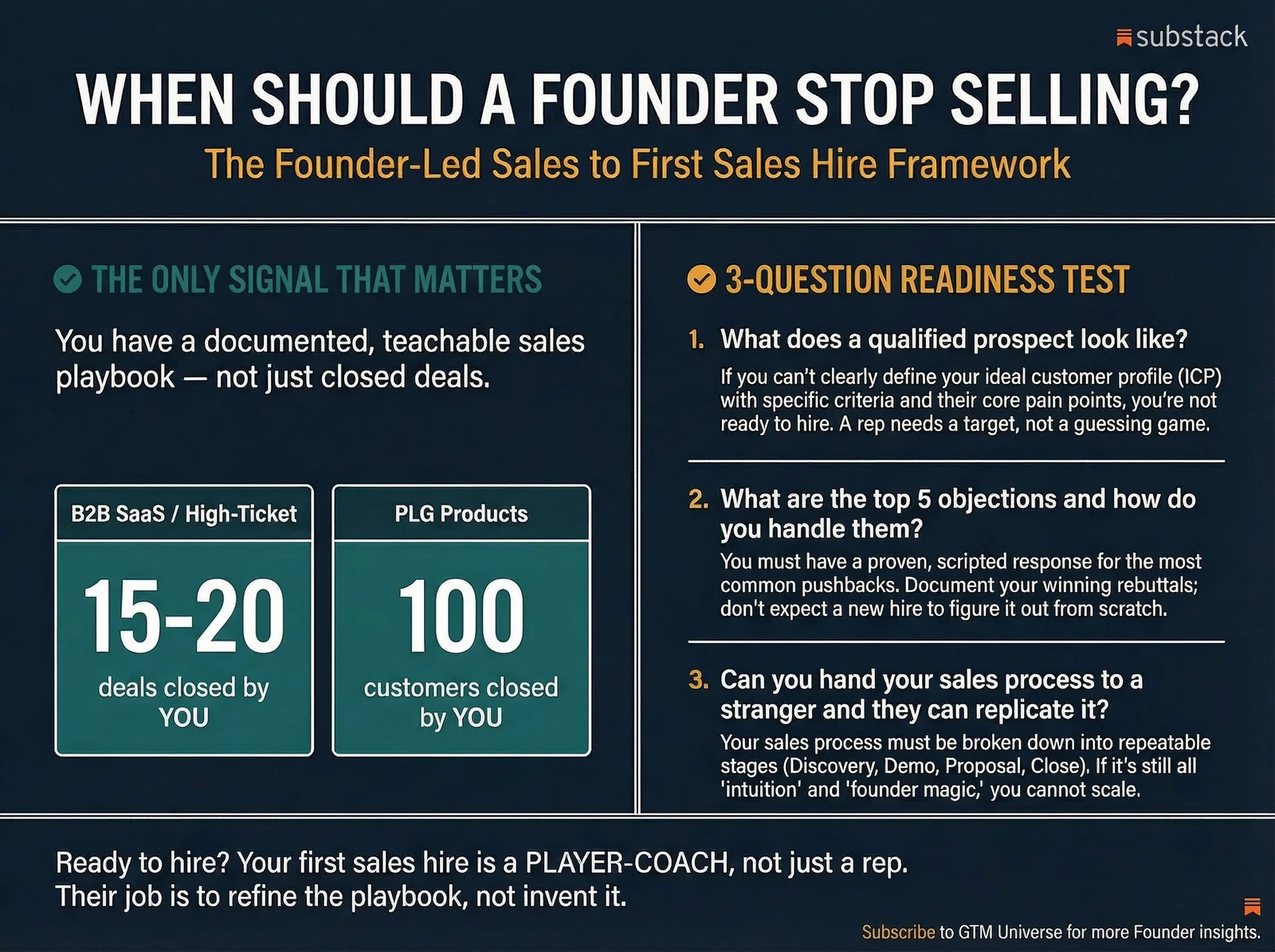
You are ready to hire your first salesperson when you have a repeatable sales engine that exists outside your own head.
Not a vague sense of how you sell. Not a Notion doc from six months ago. A living, documented, teachable sales playbook. One that a smart new hire can pick up and run with.
That playbook covers:
What your outbound messaging looks like (and what actually gets replies)
What a discovery call sounds like, start to finish, including which questions you ask, in what order, and why
Where deals typically stall and what you do when they do
How you handle the three most common objections
What your demo covers and what it intentionally leaves out
What your follow-up cadence looks like after a demo
For PLG (Product-Led Growth) products, that typically means you have personally closed the first 100 customers. For high-ticket B2B SaaS or services, the kind of deals where a single contract is $10,000 to $50,000 or more, it means you, the founder, have closed the first 15 to 20 deals. Not your co-founder. Not a warm intro that closed itself. You.
Why these numbers? Because somewhere between deal 10 and deal 20 in B2B, patterns start showing up. You stop improvising your discovery call. You already know which question unlocks the real pain. You can predict where a deal is going to stall before it stalls. That pattern recognition is the actual thing you are handing off to a salesperson. Not just the activity. The intelligence behind it.
The 3-Question Test: Are You Actually Ready?
Before you post a job description for a sales role, answer these three questions clearly and in writing, not just in your head.
1. What does a qualified prospect look like before the first call?
ICP (Ideal Customer Profile) is not just an industry and a company size. It is a specific pain, a specific context, and a specific moment in the buyer’s journey.
2. What does a good discovery call sound like, start to finish?
Not a pitch. A discovery call. What are the five to seven questions you always ask? What are you listening for? What signals tell you this is a real deal versus a polite conversation?
3. What is the single most common reason deals die and how do you handle it?
Budget? Decision-making authority? Competitor preference? Status quo inertia? Pick one and know your answer cold.
If you cannot answer all three clearly, your first salesperson cannot either. And now you have handed someone an impossible job with a ticking clock and a salary attached to it.
What Actually Happens When You Hire Too Early (A Real Pattern)
I have seen this play out multiple times with founders building in India and selling into North America.
A founder closes four or five deals through personal network and founder-to-founder referrals. Pipeline starts moving. The founder feels the pressure of managing sales alongside product. They hire a small sales team, enthusiastic, motivated, good on paper.
The team starts making calls. Sending emails. Booking demos. On paper, activity is happening.
But the team cannot articulate why the product exists. They can only explain what it does. There is no outbound playbook. No demo structure. No objection-handling framework. The deals that do close during this period are still coming from the founder’s network or warm referrals, not from anything the team independently built.
Six to eight months later: the pipeline is scattered, the CRM is a mess, the team is demoralized, and the founder is back at square one. This time with less runway, a team that has lost confidence, and a GTM motion that never got properly built.
This is not a bad hire story. This is a premature handoff story. The founder transferred ownership of something that did not yet exist as a system.
The most common version of this in the India-US corridor looks like this. The founder is staying up until midnight to cover US business hours for sales calls. They close a few deals, burn out, and hire someone to take over. Then they quietly step away from customer conversations entirely. The new hire struggles because they are not learning from the founder in real time. The founder stops hearing the voice of the US customer. Pipeline dries up. And no one knows why, because the activity metrics still look fine.
What Kind of Person Should Your First Sales Hire Be?
Not a closer. Not a hunter. Not someone with an impressive quota number from a large SaaS company where they had a recognizable brand, an SDR team feeding them qualified leads, and a full marketing engine running underneath them.
The first sales hire for an early-stage startup needs to understand how people buy, not just how to sell. There is a meaningful difference between the two.
Someone who understands buying psychology, consultative selling, and the art of building trust with a skeptical B2B buyer (one who can sit with a prospect and give them enough clarity to make a confident decision) is worth ten times a high-pressure closer in this context.
Technical product knowledge matters less than most founders think. That can be transferred. What cannot be easily transferred is commercial instinct: the ability to read a room, identify real pain, build credibility quickly, and move a deal forward without forcing it.
For founders selling from India into the US, the cultural dimension matters here too. Your first sales hire, especially if they are going to be customer-facing with US buyers, needs to understand American B2B buying behavior. The communication style, the directness, the decision-making dynamics, the way trust is built differently across US enterprise versus mid-market versus SMB. This is not about accent or location. It is about genuinely understanding how the buyer thinks.
The first sales hire also needs to believe in the founder’s vision. Not recite it robotically. Understand it. Why this solution exists, what it is genuinely trying to do for customers, and what makes it different in a noisy market. That conviction is what moves a deal forward when the product is still imperfect and the brand is still unknown.
One profile to avoid: A VP of Sales from a Series B or C company who is used to running a full revenue org with inbound demand, SDR support, and established brand recognition. In an early-stage environment with none of that infrastructure, they will likely underperform. Not because they are not talented, but because the job is completely different. You need a builder, not a manager. Someone who is energized by figuring things out with limited guidance.
What the Founder Should Still Own After the Handoff
The handoff is not an exit. It is a restructuring of responsibility.
What the founder hands off:
Outbound outreach and prospecting
Content creation for sales sequences
Demo execution
Follow-up cadence management
Day-to-day pipeline hygiene
What the founder keeps:
The overall GTM strategy, including what the ICP looks like, how the narrative is evolving, and which channels are generating qualified pipeline
Weekly metrics reviews. If deals are stalling in a pattern, the founder needs to know. If reply rates are dropping, the founder needs to ask why.
High-value deal involvement. At least in the early months, be available when the salesperson needs product depth backup or when a deal is at a critical stage. Gradually step back as they build their own credibility.
Thought leadership. No salesperson can replicate the authority that comes from a founder who is visibly building, sharing opinions, and being known in their space. LinkedIn, Substack, speaking, podcasts. That is a GTM asset only the founder can create and own.
In the India-US corridor specifically, the founder’s credibility as someone building with deep domain understanding and often strong technical depth is a genuine competitive advantage when selling to US buyers. Do not outsource that signal.
For Founders Who Say “I Hate Selling”
This comes up constantly: “I am a builder, not a seller. I just want to focus on the product.”
I understand the feeling. I have worked with dozens of founders who felt exactly this way. But it is not a valid reason to hire early. Here is why.
If you do not sell in the early stage, you do not learn what the market actually wants. Every customer conversation is simultaneously a product insight, a positioning insight, and a GTM insight. Outsourcing that in the 0 to $1M ARR phase means outsourcing your ability to build the right thing.
The mindset shift that works: you are not selling, you are solving. You are not trying to convince someone to give you money. You are finding out whether you can genuinely fix something that is costing them time, revenue, or growth. And if you can, you are making it easy for them to say yes.
Founders who absorb this shift stop dreading sales calls. They start treating them as the best market research they can do. And when they eventually hand off the activity, they hand off something real. A system built on actual understanding, not assumption.
The Honest Summary (And What to Do This Week)
Hire when you have closed enough deals to know what a repeatable process looks like. For B2B SaaS, that is 15 to 20 founder-closed deals. Not before.
Document before you hire, not after. Your first salesperson should be able to read your playbook and know what “good” looks like before their first call.
Hire for buying psychology and commercial instinct over closing credentials. An impressive quota number from a big company is not a reliable predictor of success at an early-stage startup.
Keep the GTM strategy, the metrics, and the thought leadership. Hand off the execution. Stay close to the customer even after the handoff, especially if you are selling cross-border.
And if you are avoiding sales because you hate it, that is exactly the reason to stay in it longer, not to get out faster. The founder who understands how their product sells will always build a better product than the one who does not.