 GTM Universe
ICP Definition for B2B SaaS Founders: The One Sentence Test
By Rajat Kharbanda,
A founder I was speaking with told me their ICP was any founder in the US who had raised more than one million dollars in funding.
I asked why.
“Because they can easily afford our service,” they said. “We charge five thousand dollars and a funded founder won’t hesitate.”
I stopped them. “A founder who has raised a million dollars won’t hesitate to spend even fifty thousand on the right solution. Funding level tells you nothing about whether they have the problem you solve or whether they feel it urgently enough to act. What you have is not an ICP. It is a financial filter.”
That conversation happens more than you would think. And it is costing you time and money. Because when your ICP is wrong, everything built on top of it, your messaging, your outbound, your sales motion, is wrong too. You just do not find out until you have wasted three months.
What is an ICP for a B2B SaaS founder?
An ICP, or Ideal Customer Profile, is the precise definition of the person or company that feels your problem urgently, has the means to act on it, and will get clear value from your solution. It is not a demographic filter. It is not a funding stage. It is not a company size range.
A real ICP has four elements: the industry or segment you are serving, the specific person within that segment who owns the problem, the exact outcome they are responsible for, and the value that solving it produces for them. All four. Not three.
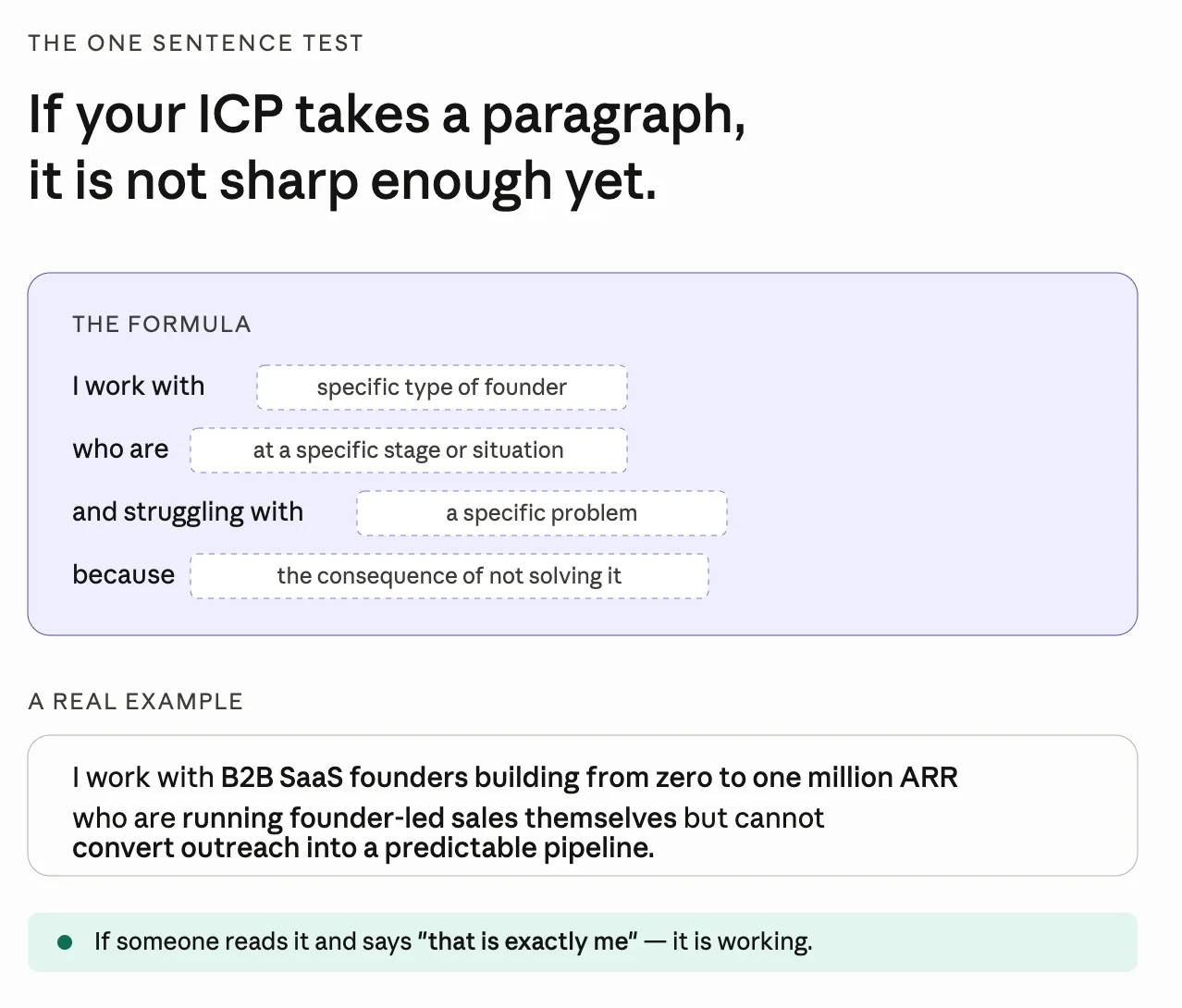
The test is simple. If you describe your ICP and someone says “that sounds exactly like us,” you have it. If they say “yeah, kind of relevant,” you do not.
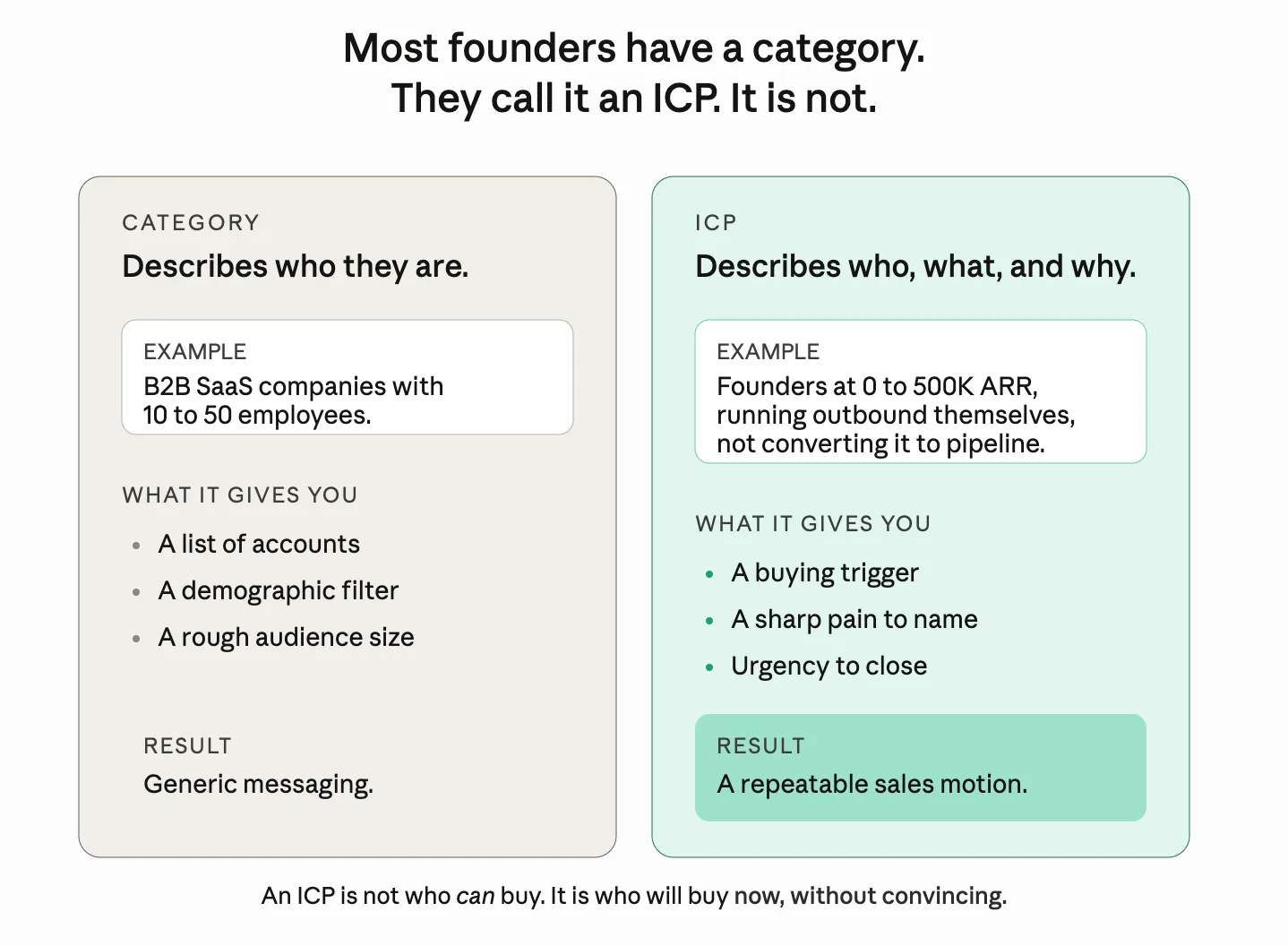
An ICP is not who can buy. It is who will buy now, without convincing.
The difference between a category and a real ICP
Most founders have a category. They call it an ICP but it is not. Here is how to tell the difference.
Category: B2B SaaS companies with 10 to 50 employees.
ICP: Founders of B2B SaaS companies at 0 to 500K ARR who are running outbound themselves, not converting meetings into pipeline, and have never had a structured GTM motion.
The category describes who they are. The ICP describes who they are, what is broken, and why they need help right now. The category gets you a list. The ICP gets you a sales motion.
The funding example from the opening is a category. So is “mid-market healthcare companies” or “e-commerce brands doing over five million in revenue.”
These are filters, not customer profiles. They tell you roughly who might be in the room. They do not tell you whether anyone in that room has a problem urgent enough to write a cheque.
The difference matters because your messaging is written for a person with a specific pain, not for a demographic. And your outbound converts when it speaks to that pain precisely, not when it speaks to a company size range.
The one thing your ICP must have that most founders leave out
Four elements make a complete ICP. But if you could only get one right, it is this: the person must feel the problem.
Not have the problem. Feel it.
Lots of companies have inefficient processes. Not all of them feel the pain of it acutely enough to spend money on fixing it this quarter. A company that has the problem but does not feel it is not a good prospect. A company that feels it so sharply they have already tried to fix it twice and failed, that is your ICP.
When you are defining your ICP, the question is not “who has this problem.” It is “who wakes up thinking about this problem. Who is accountable for the outcome. Who gets asked about it in leadership meetings. Whose performance review is affected by it.”
That person feels the problem. And feeling the problem is what creates urgency. Urgency is what closes deals.
Find the person who is accountable for the outcome your solution produces. That is your ICP.
How to write your ICP in one sentence
A usable ICP fits in one sentence. If it takes a paragraph, it is not sharp enough yet. Here is the structure:
“I work with [specific type of company or founder] who are [at a specific stage or situation] and struggling with [specific problem] because [the consequence of that problem].”
What breaks when your ICP is wrong
Everything. But in a specific order.
Outbound stops converting. You are sending messages to people who have the problem in theory but do not feel it urgently. Open rates drop. Reply rates drop. You conclude outbound does not work. Outbound works. Your ICP is wrong.
Messaging becomes generic. When you do not know exactly who you are writing to, you write to everyone. Which means you write to no one. The message has no edge because it cannot afford to have one. It has to stay vague enough to apply broadly.
Sales calls go sideways. You get meetings but they do not convert. The prospect is interested but not urgent. They ask for follow-up materials, say they will circle back, suggest reconnecting next quarter. You are talking to the right category, wrong ICP.
Proof of work becomes useless. Your case studies and client results do not land because the person reading them does not see themselves in the story. Social proof only works when the reader recognizes the problem as their own.
You cannot build a repeatable motion. If you close deals, you cannot figure out why. You cannot identify the pattern because there is no pattern. Every win looks different because you are selling to different problems in a similar wrapper.
Fix the ICP and all five of these correct themselves. Within a few weeks of tighter targeting, the data starts to look different. The right replies come in. The calls feel easier. The closes feel inevitable rather than lucky.
How to define your ICP when you have zero customers
You have no data. No wins. No patterns. Most ICP advice assumes you have existing customers to analyse. You do not. Here is what you actually do.
Pick two or three beachhead segments. A beachhead segment is a narrow slice of the market where you have a strong hypothesis that the problem exists and is felt acutely. Not where the market is biggest. Where the pain is sharpest and most accessible to you.
Write a hypothesis ICP for each. One sentence per segment. Who they are, what is broken, why it matters to them. You are not claiming these are right. You are claiming these are worth testing.
Build a small list and test the messaging. Twenty to thirty accounts per segment. Send problem-first outreach. Not pitching, just opening a conversation about the problem you think they have. The replies, or the absence of them, are data.
Have real conversations, but ask the right way. Every conversation with a potential buyer teaches you something about whether your hypothesis is right. But most founders ruin these conversations before they start by asking leading questions like “would you pay for something that solves X?” or “do you think this is a good idea?” Both questions invite polite lies.
Rob Fitzpatrick calls this The Mom Test - the idea that a good customer question is one even your mom cannot lie to you about. You do not ask if they would buy. You ask about their actual behaviour. What did you do last time this problem came up? How much time did it cost you? What did you try to fix it? How much did you spend on the fix? Did it work?
The answers to those questions are facts about the past, not opinions about the future. Facts tell you if the problem is real. Opinions tell you if the person is being polite.
That is your ICP research.
Your data turns into intelligence. Your intelligence turns into insight. The ICP you write after ten real conversations will be sharper than any ICP you could build from a spreadsheet.
The mistake is waiting until you have perfect data before committing to an ICP. You never have perfect data at the start. You have a hypothesis. Run it, learn from it, sharpen it. That is the process.
If your ICP is not converting pipeline into revenue, book a 30-minute discovery call to diagnose what is wrong.
Frequently asked questions about ICP definition for B2B SaaS founders
What is an ICP for a B2B SaaS founder?
An ICP, or Ideal Customer Profile, is the precise definition of the buyer who feels your problem urgently enough to act on it now. For B2B SaaS founders, it includes the specific industry or segment, the person within that segment who owns the outcome, the exact problem they are accountable for, and the value your solution produces for them. A real ICP is not a demographic filter. It is a buying trigger profile.
What is the difference between a category and an ICP?
A category describes who your buyer is. An ICP describes who your buyer is, what is broken in their business, and why they need to fix it now. “B2B SaaS companies with 10 to 50 employees” is a category. “B2B SaaS founders at 0 to 500K ARR who are running outbound themselves and not converting it into pipeline” is an ICP. The category gets you a list. The ICP gets you a sales motion.
How do I write my ICP in one sentence?
Use this structure: I work with [specific type of founder or company] who are [at a specific stage or situation] and struggling with [specific problem] because [the consequence of not solving it]. Every word should cut the audience smaller. If someone reads your one-sentence ICP and says “that sounds exactly like me,” it is working. If they say “kind of relevant,” keep cutting.
How do I define an ICP with zero customers?
Pick two or three beachhead segments where you have a strong hypothesis that the problem is felt acutely. Write a hypothesis ICP for each. Build a small list and test the messaging through outreach and real conversations. The replies and objections you get are your data. After ten real conversations, your ICP will be sharper than anything you could build from a spreadsheet.
Related: B2B GTM Strategy for Early-Stage Startups | B2B Messaging Framework for Startups | Founder-led Sales: The Complete Guide for Early-Stage B2B