 GTM Universe
The Inbound Engine for B2B GTM Teams: Why Most Founders Get It Wrong
By Rajat Kharbanda,
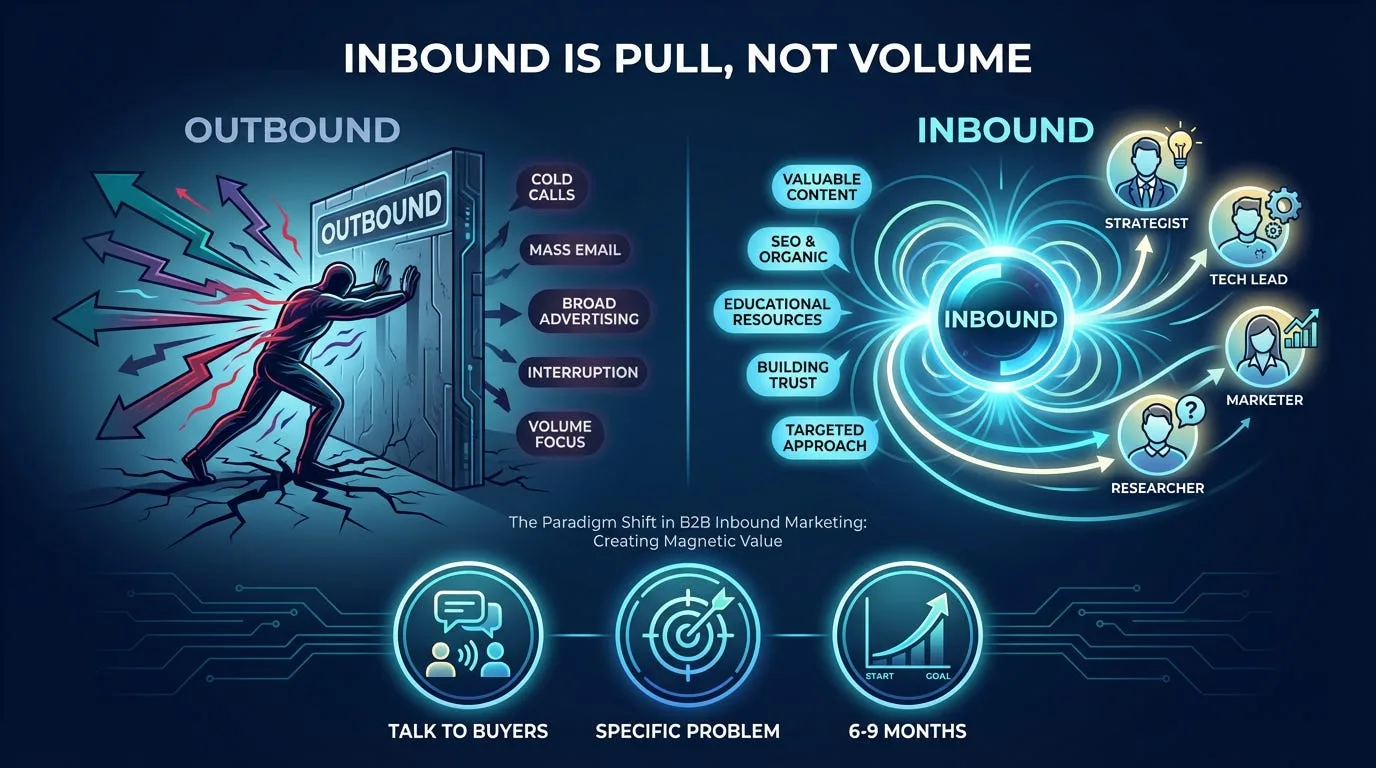
If inbound feels slow, inconsistent, or impossibly vague, you don’t have a content problem.
You have a pull problem.
Most B2B founders think inbound breaks because they’re not posting enough. Or their hooks aren’t sharp. Or they need better SEO. Or more distribution channels.
That’s rarely the issue.
Inbound breaks because it doesn’t resonate with a specific buyer facing a real, urgent problem. Without resonance, there’s no pull. And without pull, you’re just adding to the noise.
What Inbound Actually Is (And What It Isn’t)
Let’s clear something up first.
Inbound is not content marketing. It’s not posting daily. It’s not chasing impressions or virality or “top of funnel traffic.”
Inbound is the pull layer of your go-to-market engine.
If outbound is how you push into the market to validate demand, inbound is how the market slowly starts pulling you in. It exists to educate buyers, pre-sell your thinking, shorten sales cycles, and build the kind of credibility that makes cold calls feel warm.
Inbound doesn’t replace sales. It amplifies it.
If your inbound isn’t doing that, it’s just noise.
The Three Structural Reasons Inbound Fails
Here’s where most founders lose the plot.
1. You’re Talking to the Wrong Audience
Most B2B inbound content is written for “founders” or “teams” or “B2B companies.” That’s not an audience. That’s a category.
Real inbound speaks to a decision-maker with a specific role, facing a specific pain, at a specific moment in time. If the reader doesn’t immediately think, “This is about me,” they scroll.
You need to get narrow. Uncomfortably narrow.
2. Your Positioning Is Unclear
If your content explains what you do instead of why the problem exists, you’ve already lost attention.
Buyers don’t care about your solution yet. They care about whether you understand their reality. Do you see what they see? Do you feel what keeps them up at night?
Inbound without sharp positioning feels generic. And generic content never pulls demand.
3. You Quit Too Early
Inbound is a long-tail system. It compounds over six to nine months, not weeks.
Most founders stop just when authority starts forming. They post for a month, see tepid engagement, and assume it’s not working. But consistency isn’t about frequency. It’s about staying long enough for trust to build.
Here’s the truth: inbound is pull, not volume.
Why Pull Beats Push Every Time
Outbound pushes. Inbound pulls.
Pull happens when your content answers questions buyers already have in their head. Questions like: Why is this still broken? Why hasn’t this worked yet? What am I missing? What fails that nobody talks about?
If your content doesn’t answer real questions, it doesn’t pull.
Think about the last time you found a blog post or LinkedIn article that made you stop scrolling. It probably wasn’t because of a clever hook. It was because someone articulated a problem you were living through, and you thought, “Finally, someone gets it.”
That’s pull. And you can’t manufacture it with tactics alone.
Founder-Led Inbound Beats Brand-Led Inbound Early
In early to mid-stage B2B, founder-led content outperforms brand-led content for one simple reason: people buy from people.
A founder has lived the problem. They’ve seen failures up close, made hard trade-offs, and learned through mistakes. That experience is authority.
A brand page can’t replicate that early. A content agency definitely can’t.
The fastest inbound signal you can create as a founder? Talk to your customers. Everything else is secondary.
If you’re not having regular conversations with customers and buyers, your inbound will feel hollow. If you are, your content naturally sharpens. You’ll start using their language. You’ll understand what they care about versus what you think they should care about.
That gap is where most inbound dies.
The EEAT Framework: How Authority Actually Works
Inbound content that pulls demand follows a framework called EEAT: Experience, Expertise, Authority, Trust. But not in the way most people think.
Experience means you explain the problem better than the reader can. If they feel understood, they keep reading.
Expertise means you sequence solutions correctly. Not everything works for everyone, and you say that out loud. You don’t overpromise. You help people avoid what won’t work for them.
Authority is built through consistency and clarity, not engagement bait. People start referencing your ideas. They DM you with real questions. They mention you in conversations you’re not part of.
Trust comes from telling people what will fail, not just what will work. Over-promising kills inbound. Honesty builds it.
You earn EEAT through depth, not distribution.
What a Real Point of View Looks Like
A real point of view is not hot takes or contrarian posturing.
A real POV means you understand the customer’s problem, you explain why they have it, you explain why it needs to be solved now, you explain how it’s usually solved wrong, and you explain how to approach it better. You also make it clear who this isn’t for.
That POV attracts buyers. It repels dabblers. It differentiates you without shouting.
If your content doesn’t repel anyone, it’s not specific enough.
How Inbound Supports Outbound and Sales
Here’s what good inbound actually does.
It warms outbound conversations. It reduces skepticism on sales calls. It shortens decision cycles. It improves close quality.
When a prospect says, “I’ve been reading your stuff,” you’ve already won half the deal. They’re not starting from zero. They’re starting from trust.
Bad inbound creates vanity metrics. Good inbound creates context.
Distribution Reality: What Actually Matters
There’s no single best inbound channel for B2B GTM. The best channel is where your ideal customer profile already spends attention.
That said, here’s what works for most B2B founders today: long-form content should be your mothership (blogs, Substack, deep LinkedIn posts). Short-form content distributes ideas outward (LinkedIn, Twitter, clips, comments).
Long-form builds authority. Short-form builds familiarity.
SEO matters, but SEO-first content kills point of view. Write for humans first. Structure for search second. AI will scrape clarity. Humans will stay for insight.
Inbound Failure Signals: What to Watch For
Inbound is working when the right people engage, buyers ask follow-up questions, conversations deepen, warm intros start appearing, and sales cycles shorten.
Inbound is failing when only peers engage, engagement never turns into conversations, content feels repetitive, and nobody references your ideas back to you.
Don’t judge inbound in weeks. Judge it in quarters.
What Not to Do
If you want inbound to work, stop chasing trends. Stop posting daily without thinking. Stop optimizing for SEO instead of authority. Stop outsourcing your voice too early. Stop writing without customer research. Stop confusing content output with demand.
Inbound without thinking is just noise.
The Real Takeaway
Inbound works when you stop trying to impress the market and start helping one buyer think clearly.
Write for one person. Solve one problem. Say what fails. Stay consistent long enough for trust to form.
That’s how inbound turns into a B2B GTM engine, not overnight, but predictably.
If inbound feels fuzzy or forced right now, you’re not broken. Your pull just isn’t sharp yet.