 GTM Universe
B2B Messaging Framework for Startups: Stop Talking About Features
By Rajat Kharbanda,
A founder I know runs a design studio for startups. She is genuinely exceptional at what she does. Her methodology uses intuitive, meditation-informed design principles that result in fewer revision cycles and faster outcomes for her clients. She has seen it work across dozens of projects.
Her messaging said: “Affordable design partner. Brand kits delivered fast.”
Every word of that is true. None of it is why a founder hires her.
A startup founder who has just been through four rounds of logo revisions, two months of back-and-forth, a design team that keeps missing the brief, and a launch date that keeps slipping, that founder is not looking for affordable. They are looking for someone who makes the whole painful process stop. The transformation she delivers is relief from a process that drains time, money, and morale. Her messaging was not saying any of that.
This is the most common messaging problem in early-stage B2B. And it costs more deals than bad outreach, wrong channels, or weak follow-up combined.
What is a B2B messaging framework and why do most startups get it wrong?
A B2B messaging framework is the system that translates what your product does into what your buyer needs to hear. Done correctly, it leads with the transformation the buyer will experience, not the features that produce it.
Most early-stage founders get this wrong in the same direction: they are feature-heavy. They list what the product does. They explain how it works. They load the message with capabilities, integrations, and differentiators. None of which the buyer asked for.
The buyer has one question. Not “what does this do” but “what will change for me.” Saving money, making money, or saving time. That is the entire universe of outcomes a B2B buyer cares about. If your messaging does not answer that question in the first sentence, you have already lost them.
Buyers do not buy features. They buy the version of their business that exists after your solution is in it.
Why founders default to feature messaging
It is not laziness. It is proximity.
Founders are closer to their product than anyone. They know every feature, every edge case, every technical decision behind every design choice. That knowledge is a genuine asset in a sales conversation. In messaging, it is a liability.
When you know your product this well, you naturally describe it from the inside out. You start with what it is and what it does, because that is where your understanding lives. The buyer sits on the outside. They have no context for what you built. They have context only for the problem they are trying to solve.
The gap between those two perspectives is where most B2B messaging breaks down. Founders write for an audience that already understands the product. Buyers are an audience that barely understands the problem.
The fix is not to simplify the features. It is to stop leading with them entirely.
The piece most founders miss: the trigger point
Even founders who understand the outcome principle often miss the next layer. They rewrite their messaging to talk about outcomes, but they write generic outcomes. “Save time.” “Increase revenue.” “Streamline your process.”
None of that triggers anything.
The real lever in B2B messaging is the specific moment when a buyer’s pain becomes urgent enough to act. Not the pain in the abstract. The trigger point, the circumstance, the event that happens in their business and makes them reach for a solution.
For the design founder: the trigger is not “I need better design.” It is the moment a founder realizes they have now done four rounds of revisions, the launch is two months late, the team is exhausted, and the result still does not feel right. That specific moment is when she should be speaking to. That is the emotional and circumstantial state her messaging needs to meet.
When your messaging speaks to the trigger point, the reader does not just understand your product. They feel seen. And feeling seen is what turns a cold message into a reply.
The best B2B messaging does not describe your solution. It describes the moment just before a buyer needs it.
The messaging rewrite framework: work backwards from the outcome
This is the sequence to follow when writing messaging for any early-stage B2B product:
Identify the transformation. What is the specific change in the buyer’s business after your solution is in it? Not a feature improvement. A business state change. From stressed and behind, to on track and confident. From leaky pipeline, to predictable revenue. From four rounds of revisions, to a design they love on the second try. Name the before and the after.
Find the trigger point. What specific event or circumstance in the buyer’s world makes the pain urgent? When does “this is annoying” become “I need to fix this now”? That moment is the emotional entry point for your messaging. Write to that moment, not to the general problem.
Identify who feels this most acutely. Not a job title. The specific person who lies awake at night with this problem. What is their role? What are they accountable for? What happens to them personally if this problem does not get solved?
Work backwards to the why. Why does your solution produce this transformation? Not the feature list. The mechanism. One sentence. The design founder’s why: her intuition-led methodology removes the guesswork that causes revision cycles. That is the credibility layer. It comes fourth, not first.
Write the lead message. One or two sentences that speak to the trigger point, name the transformation, and imply who it is for. No features. No jargon. Nothing that requires the buyer to already understand your product.
That sequence is the framework. Everything else, the website copy, the cold outreach, the pitch deck, the LinkedIn bio, is built from those five answers.
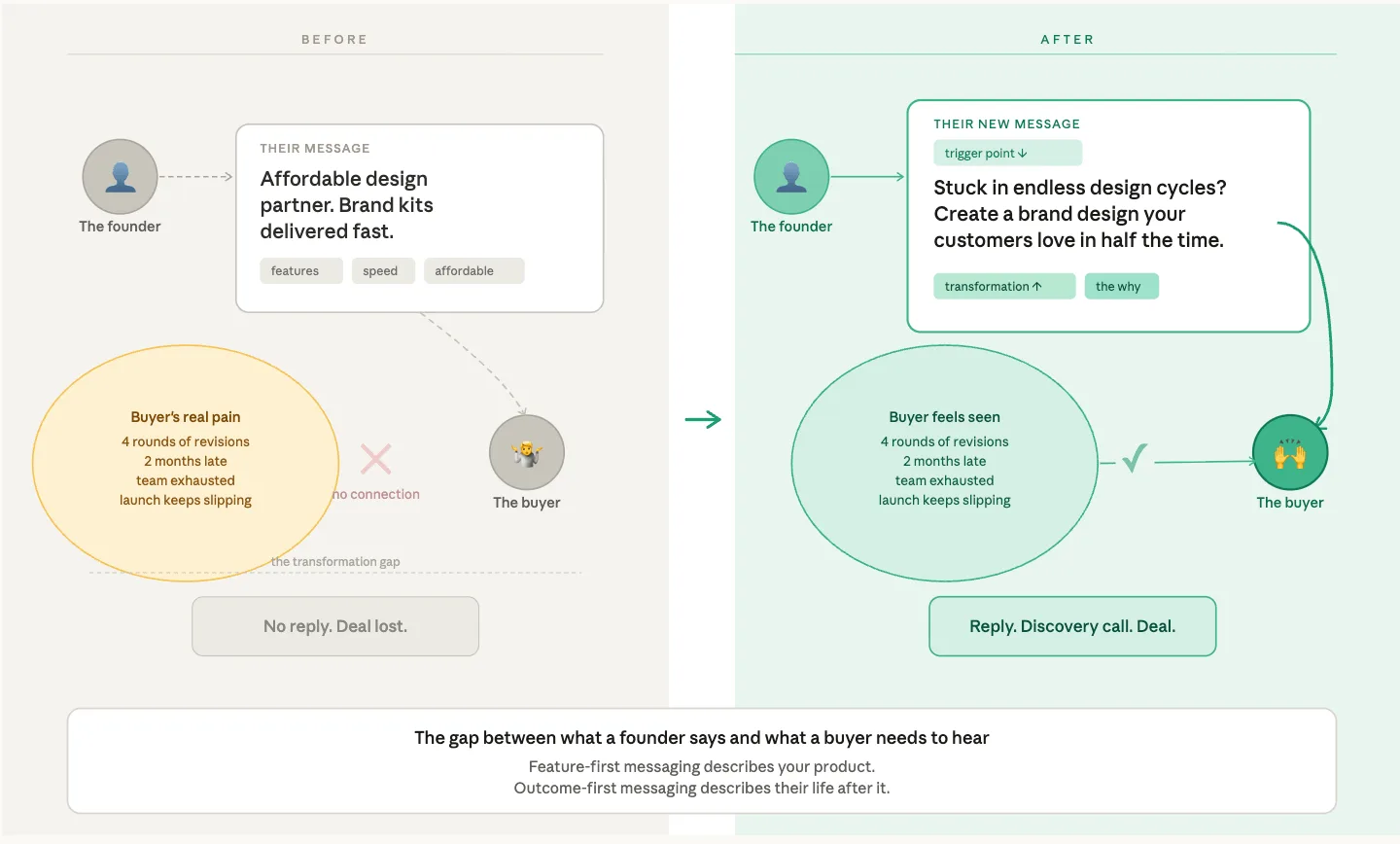
What this looks like in practice: before and after
Using the design founder example:
BEFORE: Affordable design partner. Brand kits delivered fast with fewer revisions.
AFTER: For early-stage founders who are stuck in endless design cycles: I help you get to a brand you are proud of in half the time, with half the stress, because I use intuition-led design methods that cut guesswork out of the process.
The second version does not mention affordability. It does not lead with speed. It does not describe the methodology upfront. It leads with the buyer’s trigger point (stuck in endless design cycles), names the transformation (brand you are proud of, half the time, half the stress), and gives just enough of the why (intuition-led methods that cut guesswork) to create credibility without turning into a feature list.
That is the difference. One message describes a service. The other describes a change in the buyer’s life.
Frequently asked questions about B2B messaging for startups
What is a B2B messaging framework for startups?
A B2B messaging framework is a structured approach to translating what your product does into language that speaks to what your buyer needs to experience. For early-stage startups, the most effective frameworks start with the buyer’s transformation and trigger point, then work backwards to the product. Feature-first messaging, which most founders default to, consistently underperforms outcome-first messaging in B2B sales contexts.
Why does B2B startup messaging fail?
Most startup messaging fails because founders write from the inside out. They start with what they built, describe its features and capabilities, and expect buyers to connect the dots to their own problems. Buyers do not make that connection. They respond to messaging that speaks directly to their pain, their trigger point, and the specific outcome they will experience. Rajat at GTM Universe calls this the transformation gap: the distance between what the founder says and what the buyer needs to hear.
How do I rewrite my B2B messaging to focus on outcomes?
Start by identifying the transformation: the specific before-and-after state change your buyer experiences. Then find the trigger point: the exact circumstance in their business that makes the pain urgent enough to act. Lead your messaging with those two elements. The product, the features, and the methodology come later, as credibility, not as the opening argument.
What is the difference between features and outcomes in B2B messaging?
Features describe what your product does. Outcomes describe what changes in the buyer’s business because of it. A feature is ‘real-time reporting dashboard.’ An outcome is ‘your sales team stops flying blind in the last week of the quarter.’ Buyers make decisions based on outcomes. They justify those decisions with features. Lead with the outcome. Support it with the features.
If your messaging is not converting, book a 30-minute discovery call to diagnose what is wrong. Book here:https://cal.com/rajat-kharbanda-wjoxqq/15min