 GTM Universe
The 6-Layer Revenue Engine: How B2B Founders Should Actually Build GTM
By Rajat Kharbanda,
Most early-stage B2B founders treat go-to-market as a list of activities. Run cold email. Post on LinkedIn. Hire an SDR. Try paid ads. Get on podcasts. Each activity is real. None of them, on their own, builds a revenue engine.
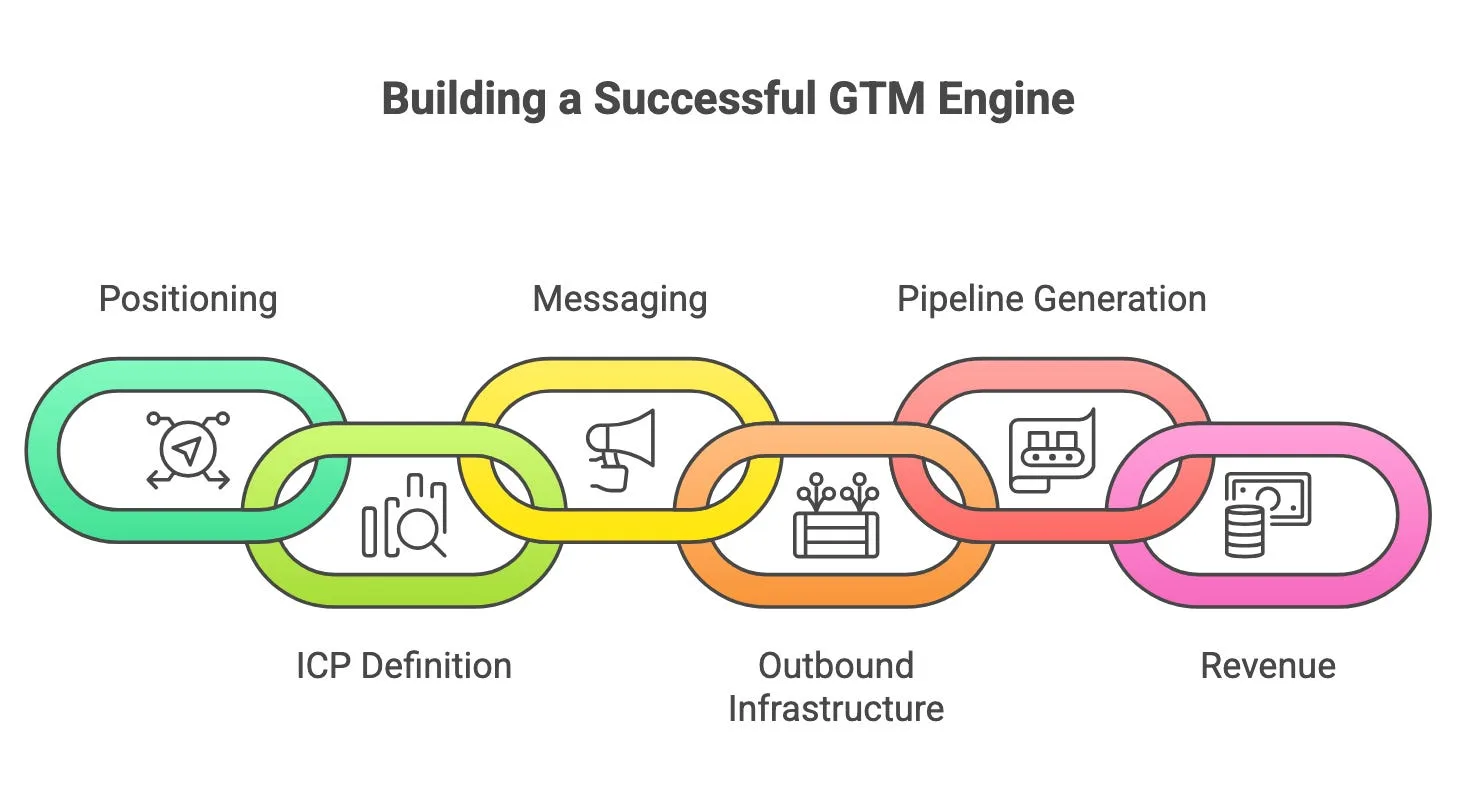
This framework gives you what to build first, how to measure and what to iterate to get real data and direction. Each of these layers feeds into the next to create the foundation of how your business generates revenue.
Positioning produces a clear category, buyer, and differentiation. That feeds ICP Definition, which produces a specific person in a specific situation. That feeds Messaging, which produces language the buyer recognizes as their own. That feeds Outbound Infrastructure, which produces the technical ability to reach them at scale. That feeds Pipeline Generation, which produces qualified conversations every week. That feeds Revenue, which produces cash in the bank.
When founders describe their GTM as “broken,” what they usually mean is that one of these six layers is broken and is silently breaking everything downstream of it. The diagnostic work is figuring out which layer. Adding more channels or tools does not do that work. Going back to the earliest broken layer is the only thing that does.
What are the layers of a B2B revenue engine?
The six layers, in order:
Layer 1: Positioning. What category are we in, who is this for, what problem do we solve, how are we different from alternatives, and why should they believe us. This is the strategic foundation. Everything else is downstream of this.
Layer 2: ICP Definition. Who specifically is the buyer, what is their situation, what triggers them to act, and how do we filter them in or out. Job Title is not enough. Situation matters more than seniority.
Layer 3: Messaging. How do we describe what we do in the buyer’s language, framed around the outcome they care about, not the features we built. Messaging is the bridge between strategy and distribution.
Layer 4: Outbound Infrastructure. The technical setup that makes outbound possible at scale. Sending domains, deliverability, sender reputation, sequencing tools, CRM hooks. Most founders skip this and assume their messaging is the problem when their setup is the actual reason emails never reaches th targetted inbox.
Layer 5: Pipeline Generation. The execution layer. How we turn infrastructure plus messaging into a repeatable motion that generates qualified conversations every week. Channel choice, signal-based prospecting, follow-up cadence, multi-threading.
Layer 6: Revenue. The conversion layer. Discovery calls, qualification, proposals, closing. Each of them has depth on its own and will be covered in upcoming publications.
This order is not negotiable. Positioning before ICP. ICP before Messaging. Messaging before Infrastructure. Infrastructure before Pipeline. Pipeline before Revenue. Each layer is the foundation the next one stands on.
Most founders build this out of order. The work of fixing it is the work of going back to the earliest broken layer and rebuilding forward from there. Not adding more tools or more channels.
How do I structure my B2B Go-To-Market Strategy from scratch?
You start with Layer 1 and you do not move to Layer 2 until Layer 1 is solid.
This sounds obvious. In practice it is the single hardest discipline for a B2B founder to hold. Founders are biased toward action. Positioning feels like thinking, not doing. ICP feels like a slide in a pitch deck, not a real exercise. So founders skip to Layer 4 or Layer 5, the layers that feel like work, and try to retrofit the earlier layers later.
Here is the example that taught me to be religious about the order. A founder I worked with was building a clinical AI product. The product helped clinicians make safer, faster diagnostic decisions. Strong technology and real outcomes in early pilots. The founder was going to market in the US and the EU simultaneously, pitching it to physicians and clinicians as a global EHR (Electronic Health Record) alternative.
Every conversation died the moment the word EHR appeared.
The reason was how the buyer’s brain processes the word EHR. An EHR is the system of record for a clinician’s daily workflow. Replacing it means full workflow disruption, retraining the practice, migrating years of patient data, absorbing regulatory and trust risk. The default answer to “would you like to replace your EHR” is no. The pitch was asking clinicians to make a drastic change.
The product was not actually replacing the EHR. It was sitting on top of it, helping with diagnostic decisions inside the existing workflow. That is not an EHR. That is a CDS, a Clinical Decision Support system.
We repositioned. Same product. Same code. Different category. The CDS framing solves the buyer’s actual problem (decision support, fewer diagnostic errors, lower clinical risk) without asking them to rip out anything they already trust. It layers on top. It adds value without adding burden.
The conversations changed inside two weeks because the strategic placement of the product in the buyer’s mind moved from “thing I have to replace my system with” to “thing that makes my existing system safer and faster.”
That is what Layer 1 does. It decides whether your buyer is willing to have the conversation at all. No amount of clever messaging or sharp outbound infrastructure rescues a product that is positioned as a replacement when it should be positioned as a layer.
Your positioning is a calculation of what your buyer has to give up or replace to adopt it. Position as a replacement, you trigger the replacement objection. Position as a layer on top of what they already trust, you remove the objection. Same software, different category, different outcome.
Once Positioning is right, you move to ICP Definition. And here is where most founders lose the next quarter.
A founder tells me their ICP is CTOs at Series A SaaS companies. I ask what changed in the buyer’s world the week before they became ready to buy. Silence. That is not an ICP. That is a LinkedIn filter.
A real ICP names the situation, not just the title. The CTO who just closed a Series A and is being asked by the board to professionalize the engineering function is a buyer. The CTO who is still pre-product-market-fit and looking for technical members is not. Same title. Two completely different sales cycles. One of them converts. The other one wastes a quarter.
Once ICP is right, you write Messaging in the language of that specific person in that specific situation. The outcome they care about, not the feature you built. If you cannot finish the sentence “after using this solution, my buyer’s business looks like…” in plain language, your messaging is not ready.
The founder who writes “we are an AI-powered platform for B2B sales teams” has not written messaging. They have written a category description.
Once Messaging is right, you build Outbound Infrastructure. Sending domains separate from your main domain. SPF, DKIM, DMARC configured properly. Warmup periods. Sender rotation. A clean technical foundation that gives your messaging a chance to land in an inbox instead of a spam folder.
The 2026 inbox placement benchmarks sit at 83.5 to 86 percent globally according to aggregate delivery monitoring logs from Instantly and industry deliverability trackers. A misconfigured setup pushes you well below that, and you will never know because the bounces and the spam folder routing are silent failures. A founder who sends from their primary domain, skips warmup, and assumes the messaging is the problem when reply rates collapse has misdiagnosed three layers in a single decision.
Once Infrastructure is solid, Pipeline Generation becomes possible. Signal-based prospecting (job changes, funding events, hiring patterns), multi-threading inside the account, follow-up cadence that does not collapse the moment the founder gets busy with delivery work.
Average cold email reply rates in 2026 sit around 3.43 percent per the Instantly 2026 benchmark. That is the floor for founders running clean infrastructure on a defined ICP. The founders hitting double-digit reply rates are the ones with all five earlier layers in place. The founders sending 2,000 emails a week and getting 11 replies are not in a volume problem. They are in a Layer 1, Layer 2, or Layer 3 problem masquerading as a Layer 5 problem.
Layer 6, Revenue, is the conversion layer. Discovery, qualification, proposals, closing. This is where the founder still has to be in the room for high-value deals. The most common failure I see at Layer 6 is the founder treating every call as a pitch opportunity. The prospect asks one question, the founder launches into a feature walkthrough, the prospect goes quiet, the deal stalls in week three.
Discovery is diagnosis. You are not in the room to sell. You are in the room to find out whether this person should be a customer, and to make the cost of inaction visible to them in their own language. The pitch comes after the diagnosis, never before.
That is the build order, start to finish. Six layers. One direction.
What does a B2B GTM stack look like for a seed-stage startup?
This is where the question gets practical. At seed stage, with five to fifty employees and limited budget, what do you actually need at each layer?
Layer 1 is a one-page positioning document. Category, buyer, problem, alternatives, differentiation, evidence. Written down. Reviewed monthly. Not a slide in a pitch deck. A working document that lives inside your business strategy, not inside your marketing folder.
Layer 2 is an ICP definition with two pieces. The buyer (title, company stage, company size, geography). And the situation (the specific trigger event, business pressure, or organizational change that makes them ready to act). The situation is what most founders skip, and it is the layer that determines whether your outbound list is full of right-fit prospects or just well-formatted noise.
Layer 3 is two documents. A positioning narrative that captures how you talk about what you do, and a messaging matrix that translates that narrative into specific outcomes, LinkedIn hooks, discovery call openers, and proposal language.
Layer 4 is technical. A dedicated outbound domain or two, separate from your main domain, fully authenticated. A sending tool (Instantly, Smartlead, or equivalent). A CRM that captures every touch. Warmup periods completed before any cold sends. None of this is exciting. All of it is non-negotiable.
Layer 5 is a weekly cadence. A specific number of new prospects added each week, a specific number of follow-ups, a specific number of LinkedIn touches. The volume can be small at seed stage. The cadence cannot be optional. Random effort produces a random pipeline.
Layer 6 is the founder’s calendar and a structured discovery framework. The founder is the highest-converting closer at seed stage. The system supports the founder. The founder does not support the system.
That is the seed-stage stack. It is intentionally low on tools and high on architecture. Tools are easy to swap. Architecture is what produces compounding output.
How should an early-stage B2B founder build their GTM engine?
By going slower than they want to.
Every founder I have worked with wants to compress this into 30 days. The honest answer is 90 to 120 days for a focused founder to build a working version of all six layers. Most founders take 18 months because they build out of sequence, hit a wall at Layer 4 or Layer 5, blame the wrong cause, and start over.
The compressed timeline is possible when the founder commits to the order. Layer 1 takes two to three weeks of structured work, not a weekend. Layer 2 takes another two weeks once you have positioning. Layer 3 sits on top of Layers 1 and 2 and takes about a week to draft, longer to refine through real outbound feedback. Layer 4 takes two to four weeks because deliverability infrastructure needs warmup time you cannot shortcut. Layer 5 starts producing signal in week six or seven. Layer 6 is ongoing, but the framework for Layer 6 can be written down in a week.
That is the realistic path. Sequential. Boring. The kind of work most founders skip because it does not feel like progress, until the day it starts producing pipeline that does not collapse when the founder takes a week off.
Replacement Positioning vs Layer Positioning
The healthcare story above is one specific case of a broader pattern. In complex regulated B2B (healthcare, legal tech, fintech, dev tools, security tooling), how you position your product against the buyer’s existing stack determines whether the conversation happens at all.
Here is the comparison block, drawn straight from that engagement.
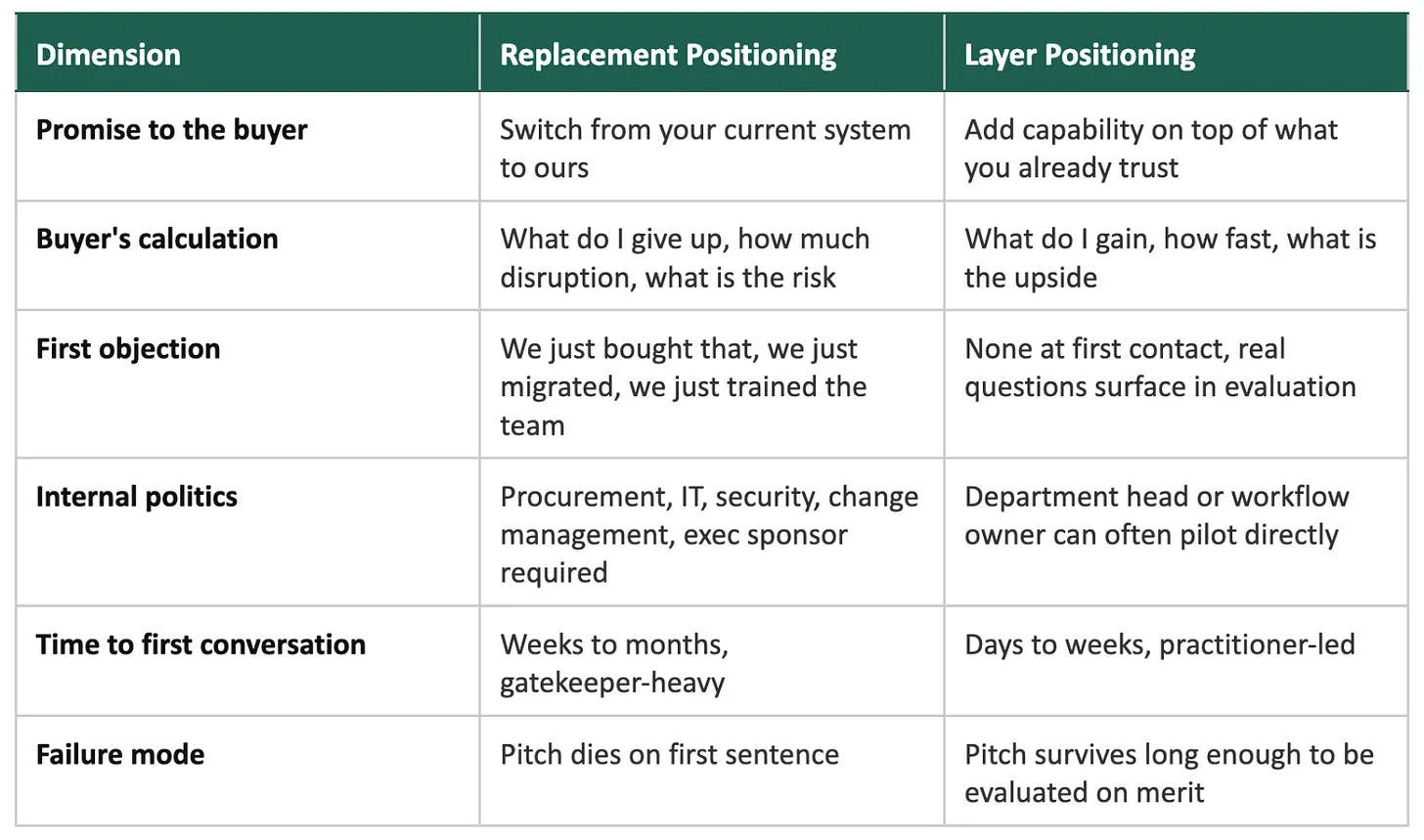
The point of the table is not that layer positioning is always correct. Sometimes the product genuinely is a replacement and the founder has to do the harder work of selling against incumbents. The point is that founders default to replacement framing because it sounds bigger and more ambitious. The buyer hears risk, disruption, and a multi-quarter rollout. The seller hears a reverberating no.
Layer positioning is not a smaller pitch. It is a different door into the same building. Same product. Different category. Different first conversation and conversion rate.
This is what Layer 1 of the engine produces when it is built carefully. Not a tagline. A strategic placement decision that determines whether every downstream layer is fighting friction or working with momentum.
Why the order matters more than any single layer
Here is the part most founders resist. The layers are not equally important. Layer 1 is more important than Layer 5. Not because Layer 5 does not matter. Because Layer 1 determines whether Layer 5 has any chance of producing real pipeline.
A founder with perfect Layer 5 execution and broken Layer 1 will generate conversations that go nowhere. A founder with mediocre Layer 5 execution and sharp Layer 1 will generate fewer conversations, but more of them will convert.
The 6-Layer Revenue Engine is not a checklist. It is a diagnostic tool. You build it in order, and when something breaks, you go back to the earliest broken layer and fix forward from there. You do not add more channels, tools, or hire your way out of it. You go back and fix the leak.
If your pipeline is leaking and you’re looking for real diagnostic solutions before revenue dries up - reach out and I’d be happy to help!