 GTM Universe
Why Your Pipeline Feels Random: The Hidden Leak in Your GTM System
By Rajat Kharbanda,
You open your CRM. A few deals moved forward. A few went cold. One looked promising last week and vanished. You scroll, refresh, and do the math. "Maybe next month will be better." It's not chaos. It just feels like it.
Here's the uncomfortable truth nobody says directly: your pipeline isn't random. It feels random because your GTM (go-to-market) system is running as a collection of disconnected activities instead of operating as one integrated decision engine.
The Difference Between Effort and Alignment
Most B2B SaaS founders blame randomness on external factors. The market is weird right now. Inbound dried up. That outbound channel used to work. The messaging must be off. Maybe you need better SDRs. Perhaps it’s time to try a new tool again.
These explanations make sense because they’re comfortable. They point outward. But they miss something critical: pipelines only feel random when the system upstream is misaligned.
When your GTM is stitched together as layers of disconnected campaigns, channels, and conversations, outcomes feel unpredictable even when effort is high. Your team might be working hard. Your messaging might be clever. Your CRM might be fully configured. None of that matters if these pieces aren’t designed to work as a single system.
What Founders Actually Do When Pipeline Feels Random
When revenue dips, most teams follow a predictable pattern. They switch tools. They rewrite messaging. They refresh the website. They add more volume: more calls, more emails, more meetings. They blame the SDR team or decide not to hire one at all. They jump between strategies every 60 to 90 days, hoping the next tactic sticks.
This isn’t irrational. It’s a stress response. When results feel unpredictable, action feels better than analysis. But here’s what matters: these moves don’t fix randomness. They mask it. Because the real problem was never effort. It was alignment.
Pipeline Randomness Is a Symptom, Not the Root Disease
A pipeline doesn’t become random at the sales stage. It becomes random much earlier, upstream, in the decisions you make about who you’re targeting, how you’re messaging, what commitment you’re asking for, and where you’re actually visible to buyers.
Randomness enters your GTM through specific weak points:
You’re talking to people who can buy, but don’t need to. If the problem isn’t urgent for them right now, buying becomes a “later” decision. Optional pain equals optional pipeline.
Your messaging explains what you do, but doesn’t confront their reality. It sounds reasonable. It doesn’t feel personal. Buyers think, “This is interesting,” not “This is about me and my situation.”
The next step feels unclear or risky. Buyers don’t know what happens next, how much effort it requires, or whether engaging now is actually worth their time. So they delay indefinitely.
Your channels don’t match how buyers actually decide. You’re comfortable in certain channels, so you double down there. But your ideal customers aren’t hanging out where you’re fishing. Volume increases. Relevance drops. Signal quality collapses.
Each of these creates weak signals. And weak signals lead to inconsistent replies, unclear feedback, false positives, and panic decisions. That’s when founders start chasing activity instead of fixing structure.
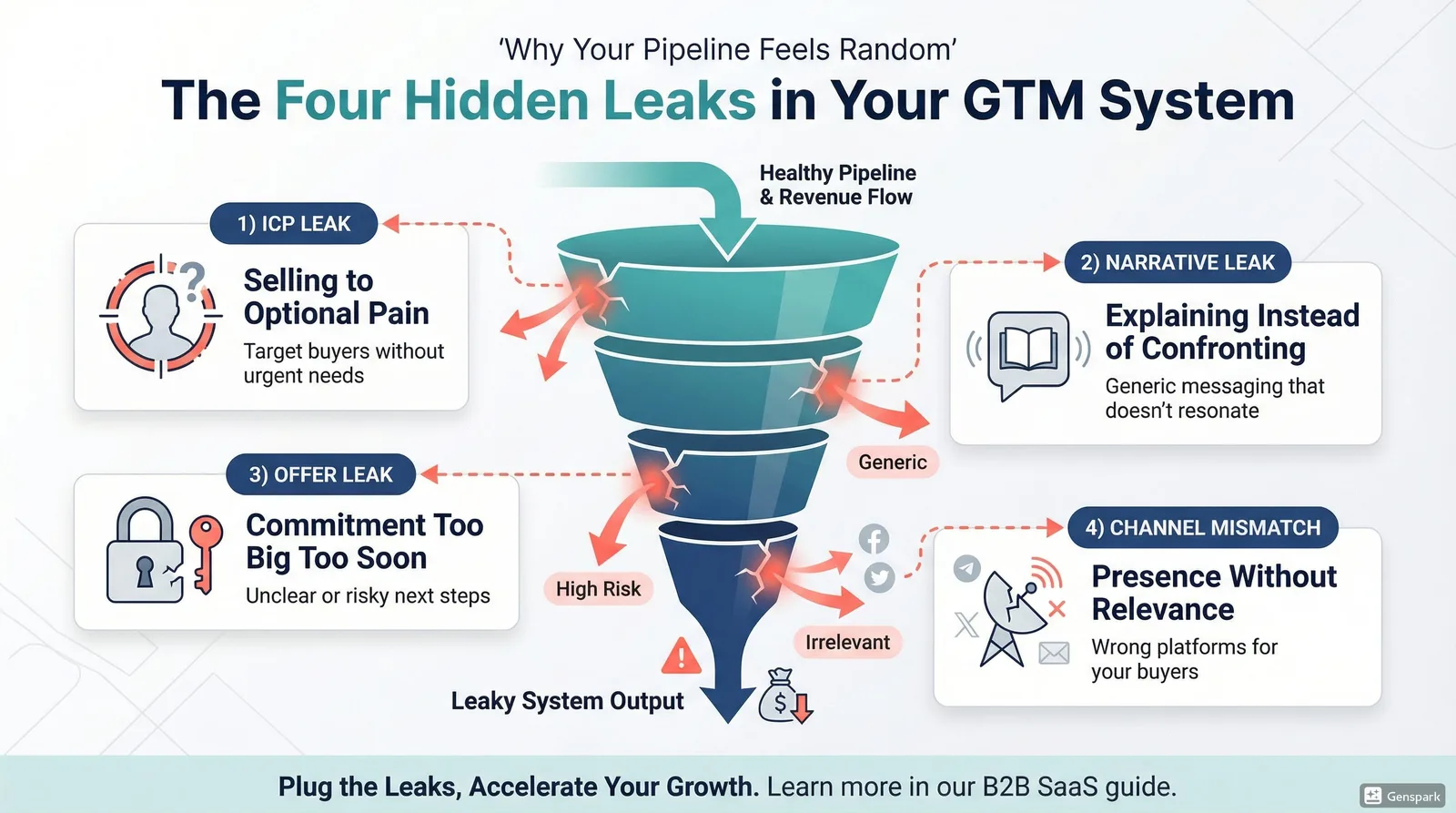
The Four Hidden Leaks in Your GTM System
ICP Leak: Selling to Optional Pain
Your Ideal Customer Profile is too broad. You’re positioning the product in a way where the problem is nice to solve rather than urgent to solve. If your ICP doesn’t have acute pain (time pressure, budget loss, momentum bleeding), they’ll always deprioritize you.
Result: conversations that feel interested but go nowhere.
Narrative Leak: Messaging That Explains Instead of Confronts
Your narrative describes features or benefits. It doesn’t hold up a mirror to the buyer’s actual situation. Strong GTM narratives force recognition. They make buyers think, “Wait, that’s exactly what’s happening to us.” Weak narratives make them think, “That’s fine, I guess.”
Result: low reply rates and conversations that don’t move forward.
Offer Leak: Commitment That Feels Too Big Too Soon
The next step you’re asking for, whether it’s a demo, a discovery call, or a pilot, feels risky or undefined to the buyer. They don’t know what engagement means, how long it takes, or what they’re committing to. Unclear offers create hesitation.
Result: people who are interested saying “maybe later” and meaning it.
Channel Mismatch: Presence Without Relevance
You’re present where it’s comfortable to reach people: the channels you like, the platforms you understand. But your buyers are making decisions somewhere else. LinkedIn messages feel random to them. Cold email feels like spam. Inbound expectations are built on noise, not signal.
Result: high volume, low relevance, and a pipeline that feels increasingly random.
Why Adding Pressure Makes It Worse
When signals are weak, the instinct is to add pressure. More outreach. More channels. More experiments. More “touches.” But pressure on a misaligned system doesn’t create clarity. It creates noise. Noise feels like randomness. And randomness makes founders lose confidence, not just in GTM, but in their own judgment.
The Founder’s Real Responsibility
Here’s what founders rarely hear directly: you are responsible for your GTM alignment. Not your marketing team. Not your sales team. Not your new hire. You. Others can help execute it. Others can optimize pieces of it. But the decision about who you’re targeting, how you’re messaging, what you’re asking for, and where you’re visible, those are founder decisions.
This isn’t blame. It’s ownership. And ownership is exactly what makes GTM predictable.
How Pipeline Becomes Predictable
Predictability doesn’t come from fancy forecasting spreadsheets. It comes from consistency of signals. When your GTM is aligned across ICP, narrative, offer, and channel:
Replies start sounding similar. Objections repeat themselves. Sales conversations follow recognizable patterns. Conversion improves in narrow segments first. That’s not luck. That’s structure. Pipeline stops feeling random when learning compounds instead of resetting every quarter.
A Simple Diagnostic
If your pipeline feels random right now, pause briefly and ask yourself these questions:
Who is this really for? Not “B2B SaaS” or “mid-market” or “companies with 50-500 employees.” One. Clear. Buyer. One persona. One title. One problem.
What painful problem is urgent right now? Something costing time, money, or momentum today, not eventually.
Why does this quarter matter? Your buyers are making decisions right now based on something. Pipeline takes time to build. If you want Q3 or Q4 outcomes, Q1 decisions about clarity matter more than volume.
Does your channel match how they actually buy? Not how you prefer to sell. Not where you have existing relationships. Where they actually decide. Where they research. Where they compare. Where they approve.
You don’t need perfect answers. You need honest ones.
The Sequence That Actually Works
Instead of chasing randomness with more tactics, do this:
Sharpen your ICP. Get specific about who feels acute pain.
Rewrite your narrative. Make it confront the problem, not explain your solution.
Simplify the offer. Create a clear, low-risk next step.
Validate through outbound before scaling. Test your clarity in direct conversation before you multiply the effort.
This doesn’t slow GTM down. It prevents wasted motion. It compresses time-to-signal because you’re only talking to the right people with the right message asking for the right thing.
The Real Truth About Pipeline Randomness
If your pipeline feels random right now, nothing is broken beyond repair. It doesn’t mean your product is bad. It doesn’t mean your team lacks hustle. It means your GTM isn’t operating as a single decision system yet.
That’s fixable.
Randomness disappears when decisions align upstream, when ICP sharpens, narrative confronts, offers clarify, and channels match buyer reality. Momentum downstream starts to feel earned, not accidental. Revenue becomes predictable. And founder confidence returns because you can finally see the connection between what you’re doing and what’s actually happening in your pipeline.
The question isn’t whether your pipeline can become predictable. The question is whether you’re willing to stop chasing activity and fix the system first.