 GTM Universe
Why Your B2B Outbound Isn't Working (Even With Great Messaging)
By Rajat Kharbanda,
The Problem: Outbound Fails Before You Send Your First Message
Most B2B outbound campaigns fail before the first email or LinkedIn message goes out.
The three most common reasons outbound fails:
Wrong target audience (ICP misfit)
Broken email and messaging infrastructure
Unclear positioning and offer
This guide is for B2B founders and GTM teams selling to the US market from anywhere in the world. If you’ve been running outbound for 90+ days and you’re getting silence, stalled deals, or ghosting, keep reading.
This isn’t a copywriting problem. It’s a go-to-market strategy problem.
Real example: A SaaS founder was targeting “VPs of Operations” globally and getting less than 2% reply rates. When they changed their focus to “VPs at 200-500 person e-commerce brands scaling internationally from Southeast Asia,” their reply rates jumped to 11% in three weeks.
What Is GTM Outbound Failure?
GTM outbound failure happens when your email and LinkedIn outreach doesn’t create sales conversations, even after you’ve tried multiple times to fix it.
Why this matters: Outbound is usually the first reliable way to generate revenue for B2B companies.
When outbound doesn’t work, everything becomes uncertain:
Your pipeline becomes unpredictable
You stop learning what works
Your team loses confidence
Outbound isn’t just a marketing channel. It’s a signal generator. It tells you if your message, offer, and audience are aligned.
When that signal is weak or missing, your GTM decisions get worse.
Outbound success depends on three things:
Who you’re targeting - Is this the right person with the right problem?
Whether your message reaches them - Does your email land in their inbox or spam?
Whether your offer creates urgency - Do they care enough to respond right now?
If any one of these breaks, outbound stops working.
Note on infrastructure: Infrastructure means email deliverability, domain health, LinkedIn activity limits, and CRM tracking. If your messages land in spam or never get delivered, you’re optimizing in the dark.
Why Outbound Failure Hurts More Than You Think
When outbound doesn’t work, teams don’t just lose deals. They lose confidence.
What happens next:
You keep rewriting your messaging instead of fixing the real problem
You start wondering if your product is the issue
Your pipeline feels random and impossible to predict
The real danger isn’t low reply rates. It’s not knowing why they’re low.
Most teams try to fix their execution (better subject lines, more personalization). The real problem usually exists before you write a single word.
This is especially true for global teams selling into the US market. Buying signals work differently across cultures. Decision-making timelines don’t match Silicon Valley patterns. A “good fit” prospect in San Francisco might behave completely differently than someone with the same title in São Paulo, Lagos, or Jakarta.
Why Outbound Breaks (Even With “Good Messaging”)
Most B2B teams struggle with outbound because they’re fixing the surface problem, not the root cause.
Symptom 1: Low Open and Reply Rates
What it looks like:
Emails don’t get opened
LinkedIn messages get ignored
Your outreach feels invisible
Why it happens:
Your ICP doesn’t feel urgent pain right now
Your infrastructure is weak or broken (emails going to spam)
Your targeting is too broad, especially when selling into the US market without clear ICP validation
How to diagnose: If fewer than 30% of prospects open your emails, check your domain reputation first. If open rates are fine but replies are below 3%, your ICP or pain point is wrong.
The impact: You get no signal. You can’t learn what works. You don’t know what to fix next.
Symptom 2: Meetings Happen, Deals Don’t
What it looks like:
Calls are happening
Prospects seem interested
But nothing moves forward
Why it happens:
Your messaging attracts curiosity, not buying intent
Your offer doesn’t clearly show time saved, revenue gained, or risk reduced
The wrong person showed up (like a user instead of a budget holder)
How to diagnose: If your meetings convert to opportunities at less than 10%, check if your offer includes a clear, measurable outcome tied to a near-term business problem.
The impact: Your pipeline looks active, but revenue doesn’t follow.
Symptom 3: Ghosted After the First Reply
What it looks like:
Prospects respond once
Then they disappear
Follow-ups get ignored
Why it happens:
Your first message creates interest, but your follow-up doesn’t create urgency
The pain isn’t urgent right now
There’s no clear “why this, why now” reason to act
How to diagnose: If more than 50% of first replies don’t lead to a second conversation, your follow-up doesn’t include a time-based trigger.
The impact: False positives waste time and mess up your GTM decisions.
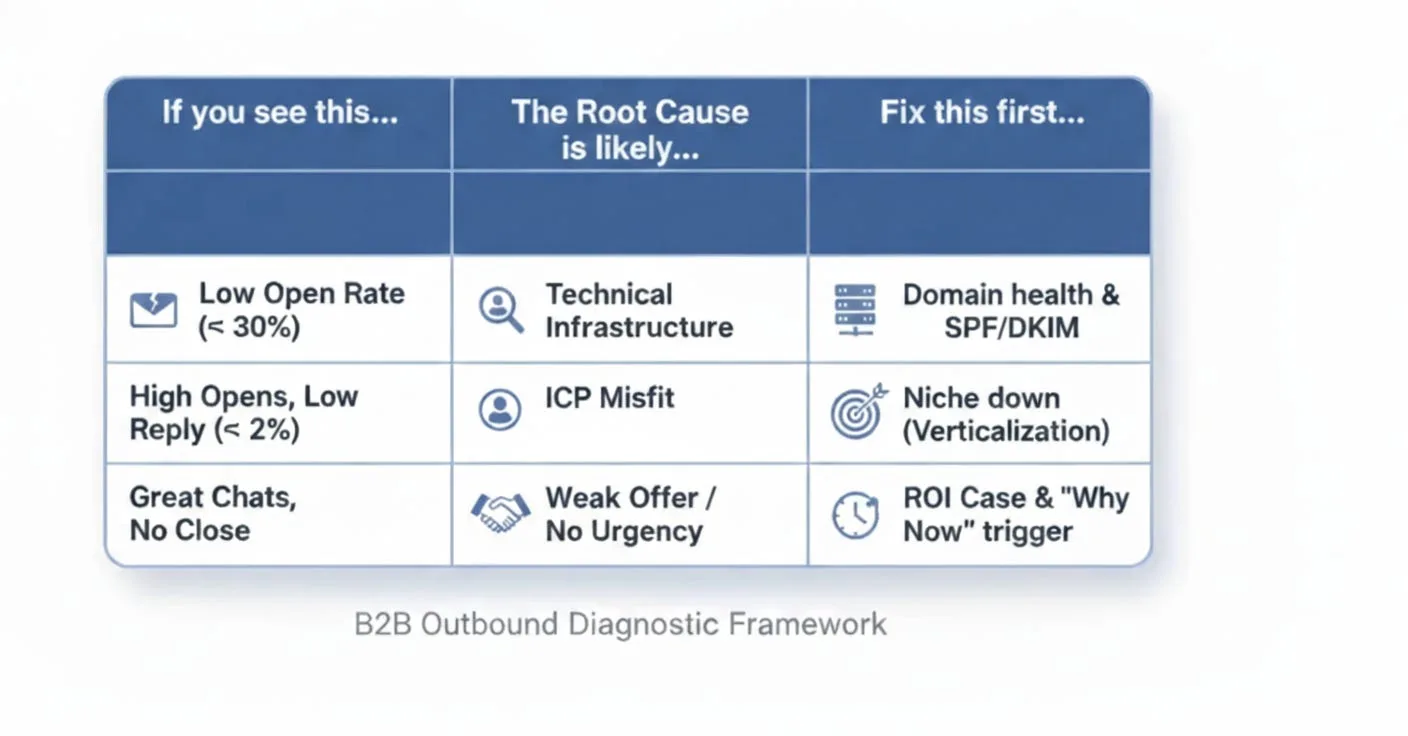
The Real Fix: Target, Deliver, and Offer
Outbound breaks when your foundation is weak, not when your subject line is boring.
For global teams selling to the US market, the margin for error is smaller. You can’t rely on LinkedIn titles or standard US playbooks. You need:
Signal-driven ICPs (based on behavior, not just titles)
Strong delivery infrastructure (so your messages actually land)
Offers that connect to real, urgent business problems (not just “efficiency gains”)
This isn’t about sending more emails. It’s about sending the right message to the right person at the right time, and knowing it will be seen.
Key Takeaways
Three reasons B2B outbound fails:
ICP misfit - targeting the wrong audience
Broken infrastructure - emails going to spam or not being delivered
Unclear positioning - offers that don’t create urgency
Three symptoms of outbound failure:
Low open and reply rates (below 30% opens or 3% replies)
Meetings that don’t convert to deals (below 10% conversion)
Ghosting after first reply (more than 50% drop off)
The solution: Fix your targeting, delivery, and offer before you optimize your copy.
Frequently Asked Questions
Q: How long should I run outbound before knowing if it’s working?
A: Give it 90 days with at least 500 qualified prospects contacted. Anything less and you don’t have enough signal to know what’s broken.
Q: What’s a “good” reply rate for B2B outbound?
A: For cold outbound, 5-8% reply rate is solid. Above 10% means you’ve nailed your ICP and messaging. Below 3% means something fundamental is broken.
Q: Should I fix my ICP or my infrastructure first?
A: Fix infrastructure first. If your emails land in spam, even perfect targeting won’t help. Check your domain health and deliverability before anything else.
Q: Can I use the same outbound strategy for US and non-US markets?
A: No. Buying behavior, decision timelines, and org structures differ significantly. What works in the US needs to be adapted for other markets, not copied.
Q: How do I know if my emails are going to spam?
A: Send test emails to Gmail, Outlook, and Yahoo addresses you control. If they land in spam or “Promotions,” your domain reputation needs work. Use tools like Mail-Tester or GlockApps to check.
Q: What’s the difference between a weak offer and bad messaging?
A: Bad messaging is about words and tone. A weak offer means you haven’t clearly connected your solution to a specific, urgent business outcome (like revenue, time, or risk).
Q: I’m getting meetings but no deals. Is this still an outbound problem?
A: Partially. It means your outbound is attracting interest but not buying intent. Tighten your ICP to target people with urgent pain, not just curiosity.
About This Framework
This outbound diagnostic framework has been used with B2B SaaS founders across emerging and global markets to identify and fix GTM leaks before they become revenue problems.
The three-part framework (ICP, Infrastructure, Offer) helps teams distinguish between execution issues and fundamental strategy problems.
Need help diagnosing your outbound problem?
DM me with your biggest symptom (1, 2, or 3) and I’ll send you the tailored diagnostic checklist I use with portfolio founders.