 GTM Universe
Why Your B2B GTM Messaging Is Failing (And What to Diagnose Before You Rewrite Anything)
By Rajat Kharbanda,
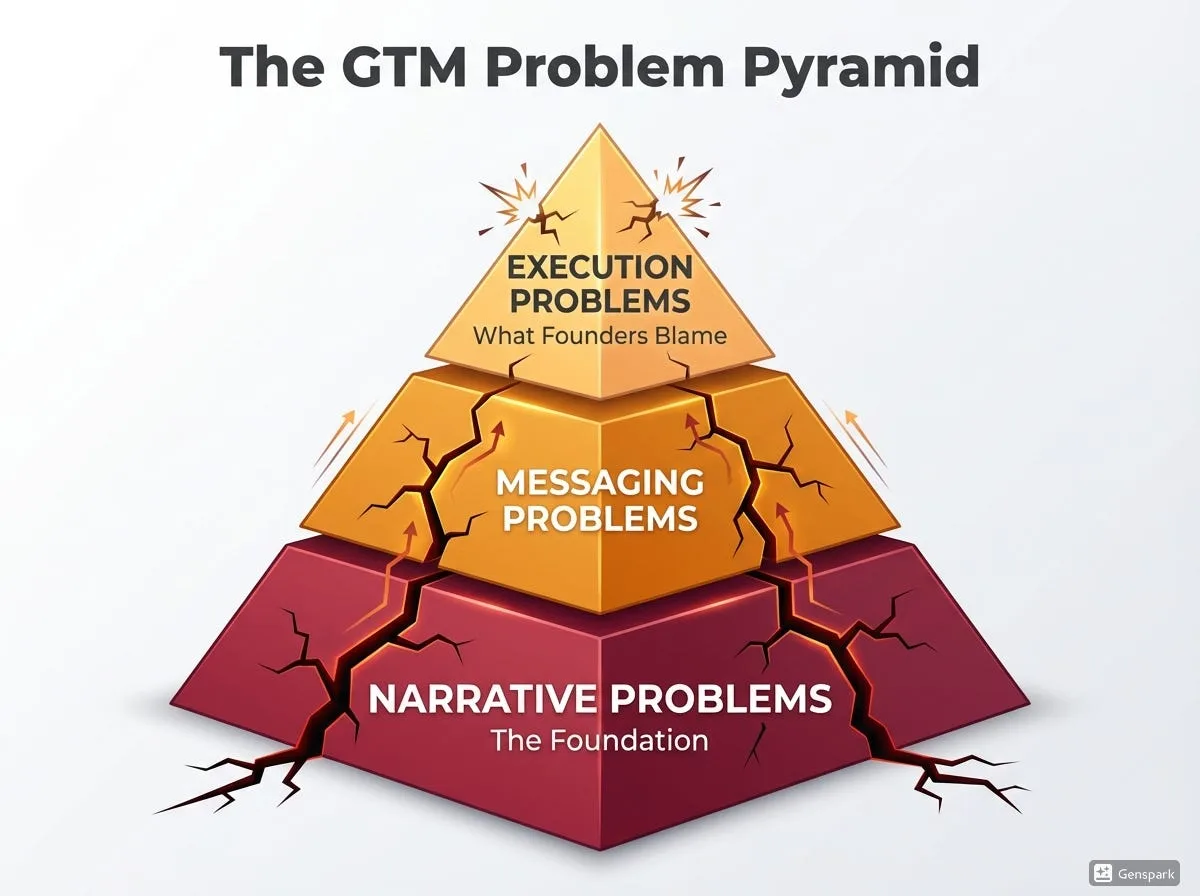
Most founders think their GTM problem is distribution.
“Outbound isn’t working.” “Inbound isn’t converting.” “People aren’t replying to our sequences.”
But when you zoom out and actually look at what’s happening, the issue usually sits one layer above execution. It’s not the channel. It’s not the copywriter. It’s the narrative - the fundamental story your business tells about who it’s for, what problem it solves, and why it matters right now.
When that clarity is missing, buyers disengage silently. And founders spend months optimizing the wrong thing.
The Real Problem Founders Are Actually Facing
When a founder says “our messaging isn’t working,” what they’re really saying is this: replies are low, the wrong people respond, conversations stall before they move forward, sales cycles stretch into months, and calls feel cold or forced. They look for explanations in subject lines, email sequences, LinkedIn optimization, or hiring better SDRs. But most of the time, the real issue is far simpler.
The buyer never saw themselves in your story.
That absence, that moment where a prospect reads your value prop and thinks “this isn’t for me” that’s what kills pipeline. Not the channel. Not the timing. The narrative.
What Broken B2B GTM Messaging Actually Looks Like
Let me show you real examples pulled from websites and outbound sequences:
“Innovate with AI. Build Intelligent Solutions. Succeed in the Future.”
“Your trusted partner in digital transformation.”
“AI-enabled no-code platform to modernize ERP and legacy applications.”
On the surface, these sound professional and capable. In reality, they communicate nothing a buyer can act on. They describe what you do, not what changes for the person reading them. And buyers don’t buy capability. They buy outcomes - time saved, money saved, risk eliminated, or problems solved.
Here’s what’s missing from every single one of these:
An explicit ICP (who this is actually for)
A specific pain point (the problem that keeps them up at night)
A concrete outcome (what their world looks like after)
A sense of urgency (why it matters now, not someday)
Without these four elements, your narrative is just marketing noise.
Why Buyers Ignore Most B2B Messaging
Here’s something most GTM teams get wrong: most B2B buyers aren’t excited when they first encounter your message. They’re cautious. Skeptical. Two emotions dominate their first impression: fear of making a bad decision and distrust of vendors making promises they can’t keep.
When a buyer scans your website or reads your cold email, they’re not asking “Is this innovative?” or “Does this sound impressive?” They’re asking three much simpler questions: Is this actually relevant to my situation? Does this solve a real problem I’m facing? And can I trust this won’t waste my time?
If those answers aren’t obvious within seconds, not minutes, seconds - they move on. Silently. No reply. No objection. Just gone.
Most B2B companies don’t actually have a narrative. They have a feature list disguised as a value prop.
Most B2B Companies Don’t Actually Have a Narrative - They Have a Feature List
This is especially true in early and mid-stage SaaS companies and high-ticket B2B businesses. What exists instead of a narrative is this: a list of features, a vague promise of “scale” or “efficiency,” and a pitch written to appeal to everyone. That’s not a narrative. That’s a product description. It’s the difference between explaining what you built and explaining why someone should care that you built it.
A real narrative helps the buyer have a moment of recognition. That moment when they read something and think “this is about me.” If that moment never happens—if your story could apply equally to a logistics company, a financial services firm, or a healthcare provider—then it applies to none of them. And if a buyer doesn’t see themselves in your story, nothing downstream works. Not the email sequence. Not the sales call. Not the demo.
How to Diagnose a Broken Narrative (Before You Rewrite)
A narrative is broken if any one of these four elements is unclear:
First, the ICP. Can the right buyer identify themselves immediately? If your story could apply to ten different audiences—startups and enterprises, different industries, different company sizes—then it applies to none of them. Specificity is not a limitation. It’s a filter. And filters work.
Second, the pain. Is the problem explicit and uncomfortable? If the pain feels optional, buying becomes optional. Vague problems lead to vague buying decisions that never close. You need to articulate the specific discomfort your buyer is experiencing. Not “businesses want to scale.” But “B2B SaaS founders are losing 40% of their pipeline because their outbound sequences are generic and their reply rates have flatlined.”
Third, the outcome. Is there a concrete change the buyer can imagine? Not “efficiency.” But time saved. Money recouped. Risk reduced. Clarity gained. Revenue unlocked. If outcomes are fuzzy, conversations stall because the buyer can’t picture what winning looks like.
Fourth, urgency. Why does this matter now and not in six months? If there’s no sense of timing or pressure, your message feels optional. The best narratives create a sense that waiting is the risk—not buying.
Where to Audit Your Narrative (In Order)
If you want to diagnose narrative problems, don’t start everywhere. Start here, in this order:
Your website hero section. This is where cold buyers decide whether to care. If your headline doesn’t signal relevance in three seconds, you’ve lost them.
Your outbound openers (emails, LinkedIn messages, sequences). These reveal whether pain and relevance are genuinely clear. If your sequences talk about benefits instead of problems, you’re missing.
Your sales call openings. These show whether the story holds under pressure. If your narrative changes across channels—if your website says one thing, your outbound says another, and your sales call says something entirely different—trust breaks.
Your website should be the source of truth. Everything else should echo it. Not reinvent it. Not soften it. Echo it.
The Before and After: What Clear Narrative Actually Looks Like
Before (broken narrative):
“We’re an AI-powered GTM platform helping B2B SaaS teams scale outreach efficiently with automation and insights.”
This sounds impressive. It means nothing.
After (clear narrative):
“We help B2B SaaS founders fix stalled outbound pipelines so they can book consistent sales conversations without hiring additional SDRs or spending more on ads.”
Now the buyer knows exactly who this is for (B2B SaaS founders). They know what’s broken (stalled outbound, low reply rates). They know what changes (consistent pipeline, fewer hires needed). That clarity alone improves replies and call quality because the right person sees themselves immediately.
What to Delete When You’re Rewriting
Most narrative improvements don’t require adding words. They require deleting them. Start by removing: ambiguous phrases like “scale,” “optimize,” “maximize.” Buzzwords like “ecosystem,” “synergy,” “best-in-class.” Feature lists disguised as benefits. Claims that apply to everyone. Credibility flexes without context.
If a sentence doesn’t help the buyer understand their problem better or imagine their outcome more clearly, it goes.
How to Run a Quick Narrative Audit
You don’t need a full rebrand. Do this instead:
Write down your actual ICP in one sentence. Not “B2B companies.” But “B2B SaaS companies with $5M-$50M ARR facing stalled outbound pipeline.”
Write down the top three problems they’re feeling today. Not “inefficiency.” But “our outbound reply rates dropped 40%, our team is burned out on manual outreach, and we can’t hire fast enough to scale.”
Write down the business impact of those problems. Revenue at risk. Time wasted. Growth stalled.
Write down the concrete outcome you help them reach. “Book 20 qualified calls per month without hiring new sales staff.”
Now read your website homepage as if you were this buyer. Does the story feel personal? Does it feel urgent? Does it feel specific to your world, or could it apply to anyone?
If it doesn’t feel personal and urgent and specific, it’s not done.
The Quiet Truth About B2B GTM Messaging
You don’t need better copywriters. You don’t need more traffic. You need a clearer story.
When narrative is right, when a buyer reads your message and says “this is exactly my problem”; everything shifts. Replies improve. Objections become sharper and easier to handle. Sales conversations feel natural instead of forced. Pipeline moves faster. Deals close.
Fix the narrative first. Then scale execution.
The diagnosis comes before the treatment. And most teams skip the diagnosis entirely.
If you’re looking for a fresh set of eyes to review your narrative, you know where to find me.